
The Fitness Industry's Lead Problem: What 105 Secret Shop Calls Reveal About How Gyms Handle New Leads

The fitness industry is thriving. Revenue is up 9.9% year over year. Membership growth is climbing at 5.5%. EBITDA margins sit at a healthy 23.6%. By all financial measures, this is an industry firing on all cylinders.
But there is a crack in the foundation that most operators either do not see or choose to ignore: the way gyms handle inbound leads is fundamentally broken.
Replify conducted an over-the-phone secret shop study of 105 fitness facilities across the United States, placing real membership inquiry calls to gyms ranging from single-location studios to national franchise locations. The results were stark.
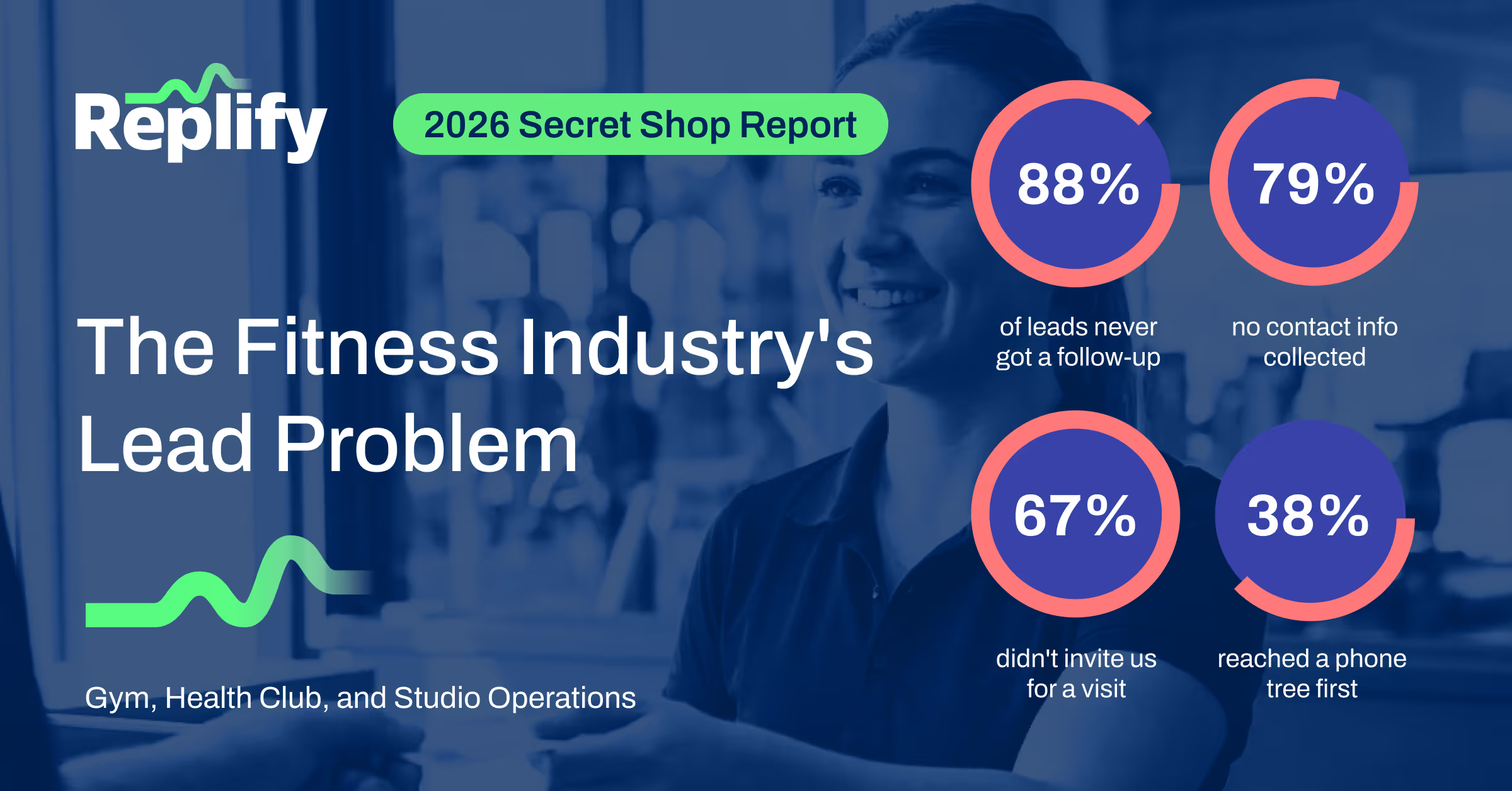
- 39% of calls never reached a live person
- 79% of conversations failed to collect contact info
- 88% of leads received zero follow-up
These are not edge cases. These are not outliers from struggling gyms. These numbers represent the industry norm. For every 100 prospective members who pick up the phone and express interest in joining a gym, the vast majority walk away without anyone knowing who they are, what they want, or how to reach them.
This report examines why the problem exists, why traditional fixes fall short, and what the data says about the approaches that actually work. The findings point toward a clear conclusion: purpose-built AI automation designed specifically for fitness is the most effective, scalable, and cost-efficient path to solving the industry's lead management crisis.

Fitness Industry Context: A Booming Market With a Hidden Problem
By any standard measure, the health and fitness industry is in a remarkable growth phase. The global wellness economy now exceeds $6.8 trillion, with fitness at its core. In the United States alone, gym membership penetration has reached 24.9%, and the high-value, low-price (HVLP) segment continues to expand aggressively into markets previously underserved by traditional operators.
The Health and Fitness Association (HFA)'s 2025 Fitness Industry Benchmarking Report, drawing on data from 175 companies operating more than 17,000 locations, paints a picture of an industry in strong financial health. Median annual revenue per location sits at approximately $2.5 million. Membership dues account for 76.5% of revenue, providing a stable recurring revenue base. High-profit operators are posting EBITDA margins above 35%.
The opportunity is enormous. According to William Blair's analysis of the HVLP fitness segment, roughly 75% of Americans still do not belong to a gym. That gap represents tens of millions of potential members. Demographic tailwinds, the rise of GLP-1 medications driving new exercise adoption, the "gym as clinic" wellness model, and the growing focus on health insurance re-imbursement are all expanding the addressable market.
But Here Is the Problem; Poor Lead Processes are Leading to Lost Revenue
All of that growth depends on one thing: converting interest into membership, and customer lifetime values (CLV), that justify hefty acquisition costs. And the single most common way a prospective member signals interest is deceptively simple. They pick up the phone and call.
What happens next determines whether that person becomes a dues-paying member or drifts to a competitor, gives up on the idea entirely, or never hears from the gym again. Our data shows that in the overwhelming majority of cases, that critical moment is being fumbled.
This is not a reflection of bad people. Front desk staff at most gyms are working hard. They are checking members in, answering questions about class schedules, handling billing issues, managing facility concerns, and doing everything they can to serve the members already in the building. When a phone rings during a busy afternoon, picking it up often means turning away from the person standing right in front of them.
The result is predictable. The phone goes unanswered, rolls to voicemail, or gets routed through an automated phone tree that feels more like calling an insurance company than a health club. The lead cools off. The moment passes.
Fitness Business Study Methodology
Between Q3 and Q4 2025, Replify conducted a blind secret shop study targeting 105 fitness facilities across the United States. The sample included a cross-section of the industry: single-location independent gyms, regional multi-site operators, and nationally franchised brands across the HVLP, mid-market, and premium segments.
Each facility was contacted via phone by a researcher posing as a prospective new member. The caller expressed genuine interest in learning about membership options and signing up. Calls were placed during standard business hours across multiple days of the week.
For each interaction, researchers tracked:
- Initial contact experience: Who or what answered the phone (live person, voicemail, automated phone tree, AI, or no answer)
- Live engagement: Whether the caller ultimately reached a live person, regardless of initial answer method
- Qualification effort: Whether the staff member asked any qualifying questions about the caller's fitness goals, experience level, or preferences
- Visit conversion attempt: Whether staff attempted to schedule an in-person visit or tour
- Contact information capture: Whether the gym collected the caller's name, phone number, or email address
- Follow-up activity: Whether the gym made any follow-up contact within 72 hours after the initial call
The methodology was designed to replicate the exact experience of a real prospective member calling a gym for the first time. No special handling was requested. No appointments were pre-scheduled. This is the raw, unfiltered experience that thousands of potential members encounter every single day.
Note on sample sizes: Not all metrics apply to all 105 calls. Qualifying questions, visit booking, and contact collection were only measurable for calls that reached a live person or advanced past an automated system (n=82). Follow-up tracking was measured for interactions where the caller provided a callback number (n=41). All percentages reflect the applicable denominator for each metric.
Results: What We Found When We Called Gyms & Studios
.avif)
First Contact: Who Answered the Phone?
The very first barrier a prospective member faces is whether anyone picks up at all. Of the 105 calls placed, the results were sobering.
- 31% were answered by a live person
- 28% went straight to voicemail
- 38% landed in an automated phone tree
- 3% received no answer at all
- 0% were answered by AI
Only 31% of calls were answered directly by a live person. More than a third (38%) landed in an automated phone tree, the kind of system that asks callers to "press 1 for membership, press 2 for billing, press 3 for class schedules." Another 28% went straight to voicemail. Three percent received no answer at all.
Perhaps most striking: not a single gym in our sample used AI to handle inbound calls. Zero out of 105. In an industry where technology adoption is accelerating across scheduling, billing, member management, and marketing, the phone -- the primary point of entry for new revenue -- remains almost entirely unautomated.
Including those who eventually navigated through phone trees and callbacks, 61% of callers ultimately reached a live person. That means 39% of prospective members who called a gym during business hours were unable to speak with anyone at all.
The Lead Funnel Breakdown
For the calls that did reach a live person, the picture does not improve much. Each step of the lead funnel represents another opportunity to convert interest into action, and at every stage, the majority of gyms fell short.
- Reached a live person: 61%
- Asked qualifying questions: 33%
- Attempted to book a visit: 33%
- Collected contact information: 21%
- Followed up: 12%
.avif)
Qualifying Questions: 33%
Only one in three staff members asked any qualifying questions at all. No "what are your fitness goals?" No "have you worked out before?" No "what's bringing you in today?" Without these basic discovery questions, there is no way to tailor the pitch, create urgency, or make the prospective member feel understood. It is the sales equivalent of a doctor skipping the examination and jumping straight to the prescription.
.avif)
Visit Booking: 33%
The ultimate goal of any inbound membership inquiry is to get the prospect through the door. A facility tour, a trial class, a personal training consultation -- any in-person visit dramatically increases conversion likelihood. Yet only one-third of staff members even attempted to schedule one.
.avif)
Contact Information: 21%
This may be the most damaging finding in the entire study. Nearly 4 out of 5 gyms failed to collect basic contact information from a person who called them expressing interest in membership. No name. No phone number. No email. The lead called, the conversation happened, and then the prospect vanished into the ether with zero way for the gym to ever reach them again.
.avif)
What Percentage of Gyms Follow-Up on Leads: 12%
Of the leads where contact information was available for follow-up tracking, only 12% received any subsequent contact from the gym. No call back. No text. No email. Nothing. Research consistently shows that the probability of converting a lead drops dramatically with each passing hour. MIT's research on lead response has found that the odds of qualifying a lead decrease by over 10x if you wait longer than five minutes to respond. The industry's 88% follow-up failure rate is not just a missed opportunity. It is revenue left on the table, compounding across every location, every day.
What's the Fix to Poor Lead Capture at Gyms?
The data makes the problem clear. The question is what to do about it. Operators generally have three paths available, each with meaningfully different trade-offs in cost, scalability, consistency, and effectiveness.
Option 1: Improve Gym Staff Training
The most intuitive response to poor phone handling is to train staff to do it better. And to be fair, better training can absolutely make a difference. Teaching front desk teams to ask qualifying questions, collect contact information, and attempt to book visits is a reasonable and well-intentioned strategy.
But it runs headfirst into several structural realities that limit its effectiveness.
- Cost and time investment. Comprehensive sales training programs can run thousands of dollars per employee. For multi-location operators with high staff turnover (the fitness industry averages turnover rates well above 50% annually), training becomes a recurring expense that never fully compounds.
- The capacity problem. Even the best-trained front desk associate cannot answer a phone while simultaneously checking in a member, resolving a billing question, and handling a facility issue. During peak hours, the phone will still go unanswered.
- Zero coverage outside business hours. Prospective members do not limit their interest to 9-to-5. Evenings, weekends, holidays, early mornings -- these are prime times when people think about fitness and reach out. A training-based approach leaves those hours entirely unaddressed.
- Consistency is nearly impossible. Even with the same training program, execution varies widely based on individual personality, motivation, workload, and day-to-day conditions. What works at Location A may fall apart at Location B.
Option 2: Outsourced Call Centers for Gyms
A second approach gaining traction in fitness is outsourcing inbound call handling to third-party call centers or virtual receptionist services. This model addresses some of the capacity and coverage gaps that training cannot.
Outsourced solutions can provide extended hours and scalable staffing, ensuring that calls are answered during off-peak times and high-volume periods alike. For operators stretched thin on front desk coverage, this can be an immediate improvement over the status quo.
However, the model carries its own significant limitations.
- Cost scales linearly. Most outsourced services charge per call, per minute, or per agent hour. As call volume grows (which is the goal), so does the expense. For a multi-location operator running promotional campaigns or experiencing seasonal surges, costs can escalate quickly and unpredictably.
- The member experience is variable. Outsourced agents are handling calls for dozens or hundreds of clients simultaneously. They may not know that your Tuesday 6pm spin class is your most popular, that your Maple Street location has limited parking, or that your January promotion ended last week. The result is often a generic, script-driven interaction that lacks the warmth and specificity prospective members expect.
- Integration gaps are common. Connecting an outsourced call center to your CRM, scheduling system, and membership management platform requires ongoing configuration and maintenance. Data handoff between the call center and in-house staff can introduce delays, errors, and dropped leads.
Option 3: Purpose-Built AI Automation for Fitness Studios and Clubs
The third path, and the one most strongly supported by both the data and the broader trajectory of business technology, is AI-powered lead management built specifically for fitness. Established AI receptionists and AI sales agents like Replify provide a turn-key option for gyms wanting to stop the lead bleed.
This is not a generic chatbot bolted onto a website. The AI systems making the biggest impact in fitness are purpose-built platforms designed to handle the full lifecycle of a lead interaction: answering inbound calls and texts, asking qualifying questions, collecting contact information, scheduling visits, and executing automated follow-up sequences. They are trained on fitness-specific workflows and integrate directly with the CRM and management tools operators already use.
The MIT NANDA State of AI in Business 2025 report offers an important framing here. Their research found that 95% of generative AI implementations fail to deliver meaningful business results. The successful 5% share a common trait: they are learning-capable, workflow-specific systems designed for defined business processes, not generic AI tools applied broadly. In other words, the AI that works is the AI built for the job.
What AI automation for gyms solves:
- 100% lead capture. Every call, text, web inquiry, and social media message is answered and logged. No leads fall through the cracks, regardless of time of day, call volume, or staffing levels.
- Consistent qualification. AI asks the right questions every time -- fitness goals, experience level, scheduling preferences -- creating a qualified lead profile that gives your sales team what they need before the prospect walks through the door.
- Instant response. AI responds in seconds, not hours or days. This alone dramatically increases the probability of conversion, as research consistently shows that speed-to-lead is among the strongest predictors of sales success.
- Automated follow-up. No more relying on busy staff to remember to call back. AI executes follow-up sequences across phone, text, and email on a configurable cadence -- persistently and consistently.
- Seamless handoff to humans. When a lead is ready for a deeper conversation, tour, or close, AI can live-transfer the call to staff, send a text notification, leave a voicemail, or trigger a task in the CRM. The AI handles the top of the funnel so your team can focus on the moments that matter.
- Location-specific intelligence. Unlike generic outsourced agents, AI can be configured with knowledge about each location's classes, pricing, promotions, hours, and amenities -- delivering a personalized experience at scale.
Case Studies: AI in Action
The theoretical case for AI automation is compelling. But operators rightly want to see real-world results. Here is what fitness brands are reporting after implementing purpose-built AI lead management.
Gold's Gym DC Metro: 10x Lead Growth
Gold's Gym DC Metro, a multi-location franchise group, deployed AI-powered lead management across its facilities and saw inbound lead volume increase by 10x. The AI captured every inquiry -- calls, texts, web chats, and social messages -- and funneled qualified prospects to the sales team with complete context. Staff could focus their energy on closing rather than chasing.
SWEAT440: 53% Support Costs Reduction
SWEAT440, one of the fastest growing fitness franchises in North America, achieved a 53% support cost reduction, by reducing their reliance on outsourced customer service by deploying AI. Prospective member conversations were handled entirely by AI, from initial contact through qualification and visit scheduling, without requiring any staff involvement. As SWEAT440 scales to 100s of franchise locations, the scale provided by AI customer service and sales is invaluable to their growth trajectory.
UFC Gym: 100% Lead Capture
UFC Gym implemented AI lead management to ensure that every single inbound inquiry -- regardless of channel or time -- receives an immediate, intelligent response. The result: 100% lead capture with zero calls going to voicemail or falling through phone trees. The AI qualifies prospects, books tours, and hands off to sales staff only when the lead is ready for a human conversation.
Read more AI receptionist and AI sales case studies.
The Fitness Industry Average vs. AI Automation
The Path Forward
The fitness industry does not have a demand problem. Membership interest is at an all-time high. Consumer awareness of the importance of physical activity -- amplified by the GLP-1 revolution, the wellness boom, and the post-pandemic return to in-person fitness -- is creating a wave of new prospects that shows no signs of cresting.
What the industry has is a conversion problem. And that conversion problem is not a mystery. It is measurable, it is documented, and most importantly, it is solvable.
The 105 secret shop calls in this study tell a consistent story: prospective members are reaching out, and gyms are letting them slip away. Not because staff do not care, but because the systems and processes in place were never designed to handle this moment effectively.
Front desk teams are doing their best with competing priorities. Phone trees and voicemails are relics of an era before consumers expected instant, personalized engagement. Training helps but cannot scale. Outsourcing adds cost without adding intelligence.
Purpose-built AI automation addresses every failure point identified in this study -- immediately, consistently, and at a fraction of the cost of the alternatives. It captures 100% of leads. It qualifies every prospect. It books visits. It follows up. It does all of this 24 hours a day, 365 days a year, across every location in a portfolio, with the same quality every time.
The operators who recognize this shift early will compound their advantage as the market continues to grow. Those who do not will continue to invest heavily in marketing that drives interest to a front door that cannot capture it.
Every missed call is a missed membership. Every uncollected contact is a lead that cannot be followed up. Every unanswered inquiry is revenue walking out the door. The data is clear. The technology exists. The only question is when you decide to fix it.
About The Fitness Industry's Lead Problem Report
This report was produced by Replify, the AI growth engine built specifically for fitness businesses. Replify's platform handles inbound and outbound lead management across phone, text, email, web chat, and social media, delivering 24/7 AI-powered engagement with seamless human handoff for gyms, health clubs, and wellness facilities of all sizes.
The secret shop data, analysis, and conclusions presented here are based on primary research conducted by the Replify team. Industry data and benchmarks are sourced from the HFA 2025 Fitness Industry Benchmarking Report, the William Blair HVLP Fitness Industry Report (July 2025), the MIT NANDA State of AI in Business 2025 Report, and the Fitt Insider State of Health and Wellness 2025 Report.
For more information, schedulea a demo to learn how AI-powered lead management can transform your gym's growth.
The Fitness Industry's Lead Problem Report Frequently Asked Questions (FAQ)
How many gyms answer the phone with a live person?
According to Replify's 2025 secret shop study of 105 fitness facilities, only 31% of calls were answered directly by a live person. Another 38% reached an automated phone tree, 28% went to voicemail, and 3% received no answer at all. When factoring in callers who eventually navigated through phone trees, 61% ultimately reached a live person, meaning 39% of prospective members were unable to speak with anyone during business hours.
What percentage of gyms collect contact information from prospective members?
Only 21% of gyms in the study collected contact information (name, phone number, or email) from callers expressing interest in membership. That means 79% of prospective members called, had a conversation, and then disappeared with no way for the gym to ever follow up. This represents one of the most significant revenue leaks in the fitness industry.
How often do gyms follow up with leads after an initial inquiry?
The study found that only 12% of leads received any follow-up contact from the gym within 72 hours of the initial call. That means 88% of prospective members who expressed interest in joining heard nothing back. Research from MIT has shown that the odds of qualifying a lead drop by over 10x when response time exceeds five minutes, making the industry's follow-up failure rate a major contributor to lost revenue.
How many gyms use AI to answer membership inquiry calls?
Zero. Out of 105 fitness facilities in the study, not a single gym used AI to handle inbound calls. Despite rapid AI adoption in scheduling, billing, and member management, the phone -- the primary entry point for new revenue -- remains almost entirely unautomated across the fitness industry.
What is the current state of the fitness industry financially?
The fitness industry is in a strong growth phase. According to the HFA 2025 Fitness Industry Benchmarking Report, median EBITDA margins are 23.6%, revenue growth is 9.9% year over year, and net membership growth is 5.5%. Median annual revenue per location is approximately $2.5 million, with high-profit operators exceeding 35% EBITDA margins. The global wellness economy exceeds $6.8 trillion, and U.S. gym penetration has reached 24.9%.
Why do gyms struggle to answer phone calls from prospective members?
Front desk staff at most gyms are managing multiple responsibilities simultaneously: checking members in, answering questions about class schedules, handling billing issues, and resolving facility concerns. When a phone rings during a busy period, picking it up often means turning away from a member standing right in front of them. The problem is not a lack of effort or care. It is a structural capacity issue where in-person service and inbound lead handling compete for the same limited resource.
What are the options for fixing gym lead management?
Operators generally have three options. First, better staff training, which improves individual call quality but cannot solve the capacity problem, does not cover after-hours inquiries, and is difficult to maintain consistently across locations with high turnover. Second, outsourced call centers, which provide extended coverage but scale linearly in cost, deliver variable member experiences, and often lack location-specific knowledge. Third, purpose-built AI automation, which captures 100% of leads across all channels 24/7, qualifies every prospect, books visits, executes follow-up sequences, and integrates with existing CRM and management tools at a fraction of the cost of alternatives.
How effective is AI lead management for gyms and fitness facilities?
Real-world case studies show significant results. Gold's Gym DC Metro saw 10x lead growth after deploying AI. SWEAT440 achieved a 74% automation rate for lead interactions across its franchise locations. Seattle Sun Tan maintained 74% automation across 50+ locations with consistent quality. UFC Gym achieved 100% lead capture with zero calls going to voicemail. AI platforms built specifically for fitness deliver 100% lead capture, instant response times, consistent qualification, and automated follow-up at every location.
What percentage of Americans belong to a gym?
U.S. gym membership penetration has reached 24.9%, according to industry analysis from William Blair. That means roughly 75% of Americans still do not belong to a gym, representing a massive untapped market for fitness operators. Trends including GLP-1 medications driving new exercise adoption, the wellness boom, and the growing gym-as-clinic model are expanding the addressable market further.
How many fitness facilities were included in the secret shop study?
The study included 105 fitness facilities across the United States, spanning single-location independent gyms, regional multi-site operators, and nationally franchised brands across the HVLP (high-value, low-price), mid-market, and premium segments. Each facility was contacted via phone by a researcher posing as a prospective new member during standard business hours.
Ready to explore AI for your health clubs, gyms, or fitness studios? Schedule a demo.
Related Articles
Replify & ABC AI Agents Product Updates: Faster Inbox, Natural Voice Greetings, Redesigned Contacts
Replify, now part of ABC Fitness, shipped updates across Chatbot, Voice, Contacts, Inbox, and Connected Apps to make the platform faster for your front desk. See what's new.
.avif)
AI Receptionist and AI Sales Updates August 2026
Your AI receptionist and AI sales agents just got updated. Updates include editing live campaigns, faster setup, inbox management, and more

AI Case Studies at Gyms, Studios, and Health Clubs
Every AI receptionist and AI sales case study KPI in one place. 200+ gyms, studios, clubs, and salons.

Heading
Lorem ipsum dolor sit amet, consectetur adipiscing elit. Suspendisse varius enim in eros elementum tristique. Duis cursus, mi quis viverra ornare, eros dolor interdum nulla, ut commodo diam libero vitae erat. Aenean faucibus nibh et justo cursus id rutrum lorem imperdiet. Nunc ut sem vitae risus tristique posuere.
Heading
Lorem ipsum dolor sit amet, consectetur adipiscing elit. Suspendisse varius enim in eros elementum tristique. Duis cursus, mi quis viverra ornare, eros dolor interdum nulla, ut commodo diam libero vitae erat. Aenean faucibus nibh et justo cursus id rutrum lorem imperdiet. Nunc ut sem vitae risus tristique posuere.
Heading
Lorem ipsum dolor sit amet, consectetur adipiscing elit. Suspendisse varius enim in eros elementum tristique. Duis cursus, mi quis viverra ornare, eros dolor interdum nulla, ut commodo diam libero vitae erat. Aenean faucibus nibh et justo cursus id rutrum lorem imperdiet. Nunc ut sem vitae risus tristique posuere.
Heading
Lorem ipsum dolor sit amet, consectetur adipiscing elit. Suspendisse varius enim in eros elementum tristique. Duis cursus, mi quis viverra ornare, eros dolor interdum nulla, ut commodo diam libero vitae erat. Aenean faucibus nibh et justo cursus id rutrum lorem imperdiet. Nunc ut sem vitae risus tristique posuere.
Heading
Lorem ipsum dolor sit amet, consectetur adipiscing elit. Suspendisse varius enim in eros elementum tristique. Duis cursus, mi quis viverra ornare, eros dolor interdum nulla, ut commodo diam libero vitae erat. Aenean faucibus nibh et justo cursus id rutrum lorem imperdiet. Nunc ut sem vitae risus tristique posuere.
Heading
Lorem ipsum dolor sit amet, consectetur adipiscing elit. Suspendisse varius enim in eros elementum tristique. Duis cursus, mi quis viverra ornare, eros dolor interdum nulla, ut commodo diam libero vitae erat. Aenean faucibus nibh et justo cursus id rutrum lorem imperdiet. Nunc ut sem vitae risus tristique posuere.