
.avif)
Nathan Corliss
Nathan Corliss
Posts

How Fitness Franchises Stop Leaving Money on the Table with AI
The Quiet Way Franchises Leave Money on the Table
Most franchise revenue does not walk out the front door. It slips through the phone. A trial member who calls with one question and never gets a callback. A lapsed payment nobody chases. A waitlist spot that opens and stays empty. None of these show up as a dramatic loss. They show up as a slow, location by location drift that a multi-unit operator only notices once the network is large enough for small leaks to add up to real numbers.
For a franchisor scaling to hundreds of studios, that drift is the central operating risk. Every new location inherits the same revenue leaks as the last one, then multiplies them. It is the core reason multi-location gyms and fitness studios turn to AI as they grow. The question that keeps franchise leaders up at night is simple to state and hard to solve: how do you make sure no franchisee is quietly leaving money on the table?
SWEAT440, one of the fastest growing fitness franchises in the United States, faced exactly this problem as it rolled out its high-intensity interval training studios across the country. Here is how the brand closed the gap with AI on the phones, and what any multi-location operator can learn from it.
Why Class-Based Franchises Are Especially Exposed
SWEAT440 runs a forty-minute, four-station circuit with a new class entering every ten minutes. The studios deliberately run without a front desk. Instructors stay on the training floor and coach every interval, which is exactly what makes the workout work. It also means the phone cannot ring in the studio, and no staff member can step away mid-session to answer it.
That structure produces a great member experience and a structural blind spot at the same time. With twenty-five locations open and more than 120 in development, routine questions about schedules, policies, waitlists, and memberships piled up across the network. Franchisees leaned on a contracted call center, but costs climbed and the answers varied from studio to studio. The system held until scale exposed its limits.
Every unanswered call at a fast-turnover studio is a potential missed trial conversion, a missed renewal, or a member who freezes instead of staying. At one location that is noise. Across 120 locations it is a budget line.
The Fix: Put AI on the Phones
After evaluating six AI vendors, SWEAT440 selected Replify for its focus on fitness and wellness, its ability to match the brand's tone, and a setup simple enough to deploy across a fast-growing network without adding labor inside studios. Replify's AI receptionist connected to the existing Zoom phone routing, answered calls instantly, resolved routine requests, and handed off anything complex to staff with clean routing for billing, class access, and manager-level issues.
The point was not to replace people. It was to stop the floor team from having to choose between coaching a class and catching a call, a choice that always ends with one of them losing.
What Six Weeks Looked Like
Beyond the numbers, the qualitative wins mattered just as much for a brand built to scale. Instructors stayed focused on coaching. Members got fast, consistent answers no matter which studio they called. Franchisees felt less pressure on the call center and gained clearer visibility into what members actually needed. The corporate team got a single support layer that moved at the brand's pace. You can read the full SWEAT440 case study for the complete rollout and results.
Where the Real Money Lives: Outbound
Answering inbound calls stops the obvious leak. The bigger opportunity for class-based operators sits on the outbound side, and it is exactly where most franchises leave the most money on the table. As SWEAT440 moves toward CRM integration, automated outreach can cover the revenue moments that go unworked when the floor team is busy coaching:
- New member onboarding calls that lock in the first few sessions, when retention is won or lost
- Outbound no-show follow-up for trial users and first workouts before they drift away
- Contract and billing reminders that recover payments before they lapse
- Waitlist promotions the moment a spot opens
- Freeze and cancellation guidance that saves the member before they call to quit
- Early engagement in the first sixty days, the window that decides lifetime value
Each of these is revenue that already exists in the network. The member signed up, the trial booked, the renewal came due. The only question is whether anyone reaches out in time. AI gives a franchise a consistent script, a uniform tone, and a repeatable process to do that across every market without piling work onto studio staff.
The Lesson for Any Multi-Location Operator
Opening doors is the visible part of franchise growth. Protecting the revenue inside those doors is the part that compounds. A support layer that answers every call, gives the same answer everywhere, and reaches out at the moments that move money turns consistency into a growth lever instead of a hope. That is what lets a network add locations without adding leaks. The same pattern shows up across other multi-location operators, from a six-location F45 and FS8 franchisee to UFC Gym and Club 24 Concept Gyms, where AI now answers thousands of calls a month across the network.
SWEAT440 enters its next phase of expansion with that layer in place. Stronger efficiency, clearer visibility into member needs, and a phone system that works for the franchise instead of against it.
FAQ Franchisor to Franchisee Revenue Support
How does AI help a fitness franchise that runs without a front desk?
It answers inbound calls instantly so instructors never have to leave the floor, resolves routine questions about schedules and memberships, and hands complex issues to staff. This keeps coaching uninterrupted while members still get fast, consistent answers.
What results did SWEAT440 see with Replify?
In the first six weeks, Replify handled more than 5,000 calls, saved 178 staff hours, and cut support costs by roughly 53 percent across the network.
How does AI reduce revenue leakage across franchise locations?
Beyond answering inbound calls, AI can run outbound outreach for no-show trials, lapsed payments, waitlist openings, and early member engagement, recovering revenue that would otherwise slip away when staff are busy with in-person service.
Does AI replace gym staff?
No. It absorbs routine, repetitive contact so staff can focus on coaching and in-person member care, and routes anything that needs a human to the right person.

AI VoIP Under the Hood: A Technical Guide | Replify
Most explainers on AI VoIP stop at "it answers your phone with a robot." If you run IT or operations, that is the marketing layer, not the system. Underneath sits a real-time media pipeline that has to ingest audio over a lossy network, transcribe it, reason over it with a language model, synthesize a reply, and push that reply back down the wire, all inside the window before a human starts to feel the silence. That window is roughly 800 milliseconds. Miss it and the conversation feels broken no matter how good the model is.
This is the wonky guide. We are going to walk the full path of a single call, count the milliseconds, look at the telephony plumbing nobody enjoys, and talk about where the architecture is going. If you want the business-side version first, the AI VoIP guide for gyms and fitness covers the why. This piece is the how.
Anatomy of a single AI VoIP turn
Every conversational turn runs the same loop. Caller speaks, system listens, system thinks, system replies. In a traditional phone tree that loop is a DTMF keypress and a branch. In AI VoIP it is a chain of streaming subsystems, each adding latency:
- Media ingress. Caller audio arrives as RTP packets, usually 20 millisecond frames, over a SIP trunk or a WebRTC session.
- Endpointing. The system has to decide when the caller has stopped talking. This is the single most underrated source of perceived latency.
- Speech to text (ASR). Streaming automatic speech recognition emits partial transcripts as audio arrives, then a finalized transcript at end of turn.
- Reasoning (LLM). The transcript, plus conversation state and any retrieved knowledge, goes to a language model that decides what to say and whether to call a tool.
- Text to speech (TTS). The reply is synthesized, ideally streamed so the first audio chunk plays before the full sentence is generated.
- Media egress. Synthesized audio is packetized back into RTP and sent to the caller.
The trick is that these stages overlap. A well-built stack does not wait for a final transcript before warming up the model, and it does not wait for the full model response before starting speech synthesis. Pipelining is what separates a system that feels conversational from one that feels like a walkie-talkie.
The latency budget, line by line
Conversational comfort lives under about 800 milliseconds of round-trip response time, and the best systems target the sub-500 millisecond range. Here is roughly where that budget goes. Treat these as order-of-magnitude figures, not guarantees:
The numbers above are illustrative and will vary with model choice, region, codec, and network path. They are here to show where time accumulates, not to benchmark any specific platform. The point: endpointing and time to first token dominate, and they are where engineering effort actually moves the needle.
Notice what is not on the list: total response generation time. Users do not perceive how long the full sentence took to generate. They perceive the gap between when they stopped talking and when audio started playing. Optimize for time to first audio, not total throughput.
Endpointing and barge-in: the hard part nobody markets
Knowing when a human has finished a thought is deceptively difficult. A naive system waits for a fixed silence threshold, say 700 milliseconds, then responds. Set it too short and the agent interrupts every time the caller takes a breath. Set it too long and the agent feels slow and dim. The current state of the art uses semantic endpointing: a small model that looks at the partial transcript and predicts whether the utterance is complete, so "my account number is" holds the floor while "my account number is four five five" can be treated as done.
Barge-in is the mirror image. When the caller starts talking while the agent is speaking, the agent has to stop synthesizing, flush its playout buffer, and start listening, in under a couple hundred milliseconds, or it talks over the human. This requires full-duplex audio handling, not the half-duplex push-to-talk model that a lot of early voice bots shipped with. If a system cannot be interrupted gracefully, your ops team will hear about it from frustrated callers within the first week.
The transport layer: SIP, RTP, codecs, and SBCs
Underneath the AI is ordinary, unglamorous telephony. Signaling is typically SIP (Session Initiation Protocol), which sets up, modifies, and tears down the call. The actual audio rides RTP over UDP, because you would rather drop a late packet than wait for a retransmit and blow your latency budget. A Session Border Controller (SBC) sits at the edge to handle NAT traversal, security, and protocol normalization between carriers who all interpret the SIP spec slightly differently.
Codec choice matters more than people expect:
- G.711 is the PSTN baseline. Uncompressed, 64 kbps, narrowband 8 kHz. It sounds like a phone because it is the phone. Universally supported, zero compression artifacts, but you are stuck at telephone bandwidth.
- Opus is the WebRTC favorite. Variable bitrate, wideband or fullband, resilient to packet loss with built-in forward error correction. If your call originates in a browser or app, you can carry far better audio, which directly improves ASR accuracy.
Here is the operational catch: ASR accuracy is bounded by input audio quality. A call transcoded down to narrowband G.711 across three carriers will transcribe worse than the same speech captured at wideband, full stop. When you can control the path, keeping audio wideband end to end is one of the cheapest accuracy wins available.
Knowledge and actions: RAG and tool calling
An AI VoIP agent that can only chat is a demo. An agent that can do things is a system. Two mechanisms make that happen:
- Retrieval (RAG). Instead of baking your hours, pricing, and policies into a prompt, the system retrieves the relevant snippets at query time from an indexed knowledge base. This keeps answers current and lets you update knowledge without redeploying anything.
- Tool calling. The model can invoke functions: look up an account, book a slot, transfer a call, write a record to your CRM. This is where the AI stops being a transcript generator and starts being an operator. It also introduces a latency consideration, because a synchronous tool call mid-turn adds its own round trip, which is why good systems mask that delay with a natural filler phrase while the call runs.
From an integration standpoint, this is the part your team will live in. The agent is only as useful as the systems it can reach, which is why integration coverage is worth scrutinizing before anything else. A platform that logs to your existing CRM and tooling beats one that strands call data in its own silo.
Telephony reality: numbers, caller ID, and deliverability
Outbound is where compliance and engineering collide. A few things every ops lead should have on the radar:
- STIR/SHAKEN. The framework carriers use to cryptographically attest that a caller ID is legitimate. Calls without a strong attestation increasingly get flagged or labeled "Spam Likely," which tanks answer rates. If you are running outbound campaigns, attestation level is not a nice-to-have.
- Number reputation. Burn a number with too many short-duration or unanswered calls and carriers will start filtering it. Healthy systems rotate and warm numbers and monitor reputation as a first-class metric.
- Consent and compliance. Outbound calling sits under regulations like the TCPA in the US. The platform should make consent tracking and suppression list handling straightforward rather than leaving it as your problem to bolt on later.
This is precisely the territory that AI outbound sales and automated billing and collections outreach have to navigate, and it is why "can it dial out" is a much deeper question than it sounds.
Reliability, observability, and what to actually log
A phone system that drops calls is worse than no system, because the caller already had an expectation. Real-time media makes resilience harder than a typical web service: you cannot just retry a failed request when the request is a live human voice.
What separates a production-grade deployment:
- Graceful degradation. If the model or a downstream tool is slow or down, the agent should fall back cleanly to a transfer or a callback, not dead air.
- Full-call observability. Per-turn timing for each pipeline stage, transcripts, tool-call traces, and audio recordings, so when a call goes sideways you can see whether it was endpointing, the model, a tool timeout, or the network.
- Regional redundancy. Media servers close to the caller to keep round trips short, with failover across regions.
If you cannot answer "why did this specific call go badly" from your logs, you do not have observability, you have hope.
Security and compliance
Voice is PII, and often more. The baseline expectations:
- Encryption in transit.
SRTPfor the media,TLSfor the signaling. Unencrypted RTP in 2026 is malpractice. - PII handling. Sensitive fields like payment data should be redacted from transcripts and recordings, ideally before they are ever persisted.
- Attestations. Depending on your sector, SOC 2, HIPAA, or PCI scope determines what the platform is allowed to touch. Verify the attestation matches your actual data flow, not just the marketing claim.
- Data residency. Where transcripts and recordings live, and for how long, is a question your compliance team will ask before your engineers do.
Where this is heading
The architecture described above, ASR then LLM then TTS as discrete stages, is already starting to collapse. The forward-looking shifts worth watching:
- Speech to speech models. Instead of transcribing to text, reasoning, and re-synthesizing, end-to-end speech models reason directly over audio. This removes whole stages from the pipeline, cutting latency and preserving paralinguistic signal like tone and emphasis that text throws away.
- Sub-300 millisecond round trips. As models get faster at time to first token and synthesis gets cheaper, the comfortable conversational floor keeps dropping. The gap between talking to a machine and talking to a person is closing on the latency axis specifically.
- Agentic call flows. Less scripted branching, more goal-directed behavior where the agent plans, calls tools, and recovers from failure on its own. The phone tree is becoming a worker.
- Native emotion and prosody. Synthesis that carries appropriate emphasis, pacing, and warmth, rather than the flat affect that gave early voice bots away in one sentence.
For operators, the practical takeaway is that the unit of automation is moving from "the call" to "the outcome." That is also the architecture behind a unified AI receptionist and sales suite rather than a bolt-on voice bot, and it is the bet behind Replify's AI VoIP, currently in beta.
AI VoIP Frequently asked questions
What actually makes AI VoIP different from regular VoIP, technically?
Regular VoIP carries voice over the internet using SIP for signaling and RTP for media, then connects two humans. AI VoIP adds a real-time conversational pipeline on top, streaming speech recognition, a language model for reasoning and tool calling, and speech synthesis, so the system can understand and respond on the call rather than just route it.
What is a realistic latency target for conversational AI VoIP?
Perceived response time under roughly 800 milliseconds feels conversational, and the strongest systems target the sub-500 millisecond range. The figure that matters is time to first audio after the caller stops speaking, not total generation time. Endpointing and model time to first token are usually the largest contributors.
Why does codec choice affect transcription accuracy?
Speech recognition quality is bounded by input audio quality. Narrowband codecs like G.711 cap audio at telephone bandwidth, while wideband codecs like Opus preserve more of the signal. Keeping audio wideband end to end, where you control the path, measurably improves transcription accuracy.
How does an AI VoIP agent take actions like booking or CRM updates?
Through tool calling. The language model can invoke functions during the conversation to look up records, book slots, transfer the call, or write to your CRM. Retrieval (RAG) handles knowledge so answers stay current without redeploying, and integration coverage determines what the agent can actually reach.
What should I monitor in an AI VoIP deployment?
Per-turn timing for each pipeline stage, transcripts, tool-call traces, recordings, call completion and transfer rates, and for outbound, number reputation and caller ID attestation. If you cannot diagnose why a specific call went badly from your logs, you lack real observability.
AI VoIP for Gyms: The Complete Guide | Replify
Your phone rings during the 6 PM rush. The front desk is checking in members, your trainers are on the floor, and a prospect who just searched for a gym near them is calling to ask about membership options. Nobody can get to the phone. That prospect hangs up and calls the next gym on their list. For multi-location operators, this plays out hundreds of times a week, and it is exactly the problem AI VoIP was built to solve.
This guide explains what AI VoIP is, how it differs from the phone system you probably have today, and why it matters specifically for gyms, studios, and franchise groups running several to hundreds of locations.
What is AI VoIP?
AI VoIP is a business phone system that combines internet-based calling (Voice over Internet Protocol) with artificial intelligence. Traditional VoIP carries voice over the internet instead of a copper phone line, which makes calling cheaper and more flexible. It still does one job: connect two people so they can talk.
AI VoIP goes further. By layering speech recognition, natural language understanding, and large language models on top of the phone line, the system can do the work a person would normally do on the call. It answers, understands the question, responds in a natural voice, captures the caller's details, books or reschedules, and transfers to a staff member only when the conversation genuinely needs one. In short, traditional VoIP routes the call. AI VoIP handles it.
AI VoIP vs traditional VoIP
The difference is easiest to see side by side.
Core capabilities of AI VoIP
Modern AI VoIP platforms share a common set of capabilities. The ones that matter most for a service business are:
- Conversational voice answering. The AI picks up, understands what the caller wants, and responds naturally, the way a well-trained front desk would.
- Automatic lead capture. Every inbound caller's name, number, and intent is recorded and synced to your CRM, so no prospect slips through.
- Live transfers. Complex or high-value conversations are handed to a human team member with the context already gathered.
- Outbound campaigns. The same system can dial out for new-member follow-ups, win-back, and billing reminders.
- Omnichannel coverage. Phone, text, and email handled from one place, so the conversation continues on whatever channel the customer prefers.
- Centralized management. One dashboard to configure, monitor, and report on every location's agent.
If you want the full feature breakdown of how this works inside one platform, see the Replify AI VoIP page.
Why multi-location fitness operators need AI VoIP
Generic AI VoIP coverage exists for almost every industry, but the math is sharpest for operators running multiple sites. A single gym can sometimes muscle through call volume with a dedicated front desk. A group of ten, twenty, or two hundred locations cannot, and the failure points compound:
- Missed calls equal missed members. Peak hours at the desk are also peak hours for inbound calls. Every unanswered call during the evening rush is a prospect deciding between you and a competitor.
- Inconsistent answers across sites. When every location handles its own phones, the quality and accuracy of what callers hear varies wildly. A centralized AI agent delivers the same on-brand message everywhere.
- Staff pulled off the floor. Time spent on routine phone questions is time not spent on member experience, tours, and retention, which is where your team actually moves the needle.
- Revenue leaking through billing gaps. Failed payments and lapsed memberships rarely get a follow-up call when staff are stretched. Automated outreach recovers revenue that would otherwise quietly disappear.
This is the same architecture trusted by brands like Gold's Gym, UFC Gym, and SWEAT440 to manage customer service and sales across many locations from one place.
The business case: an illustrative example
To make the benefit concrete, consider a simplified scenario. Imagine a group of five locations, each fielding roughly 40 inbound calls a day. If a front desk team member spends an average of four minutes per call, that is more than 13 hours of phone time across the group every day, before a single tour is given or a class is checked in.
If AI VoIP resolves even 70 percent of those calls on its own (a figure in line with what operators report once routine inquiries are automated), the system absorbs the bulk of that load. Staff are freed for the in-person work that drives retention, and after-hours callers who would have hit voicemail are now captured and converted.
The numbers above are illustrative only. They are meant to show how the math scales with location count and call volume, not to predict results for any specific business. Actual outcomes depend on your call mix, staffing, and how the agents are configured.
What to look for when evaluating an AI VoIP platform
Not every AI VoIP product is built for a multi-location service operator. When you evaluate options, weigh these factors:
- Centralized control across locations. Can you manage every site from one dashboard, or does each location become its own project to maintain?
- Built for your industry. A platform that understands fitness language, membership models, and class scheduling will need far less tuning than a general-purpose tool.
- Integrated sales and service. Look for a system where inbound answering, outbound campaigns, and live transfers all run on the same platform rather than three disconnected tools.
- CRM and tooling fit. Confirm it logs to the systems you already run so call data is not stranded.
- Transparent terms. Favor providers with clear pricing, no heavy setup, and no long-term lock-in while you prove out the results.
How AI VoIP works, and how to get started
Standing up an AI VoIP agent is faster than most operators expect. The typical path is:
- Train the agent. Point it at your website, PDFs, and documents so it learns your hours, pricing, and policies.
- Customize the experience. Set the voice, personality, and conversation flow to match your brand across every location.
- Go live. The agent begins answering inbound calls and can run outbound campaigns within days.
- Configure live transfers. Route the complex or high-priority calls to your team, with context attached.
From there, the same platform can extend into outbound sales and billing and collections outreach, all coordinated through one AI receptionist and sales suite. If you operate gyms or studios specifically, the fitness solutions page covers the vertical in more detail.
AI VoIP for Gyms Frequently asked questions
What is AI VoIP?
AI VoIP is a business phone system that pairs internet-based calling with artificial intelligence. Instead of simply connecting calls like a traditional VoIP line, it answers inbound calls automatically, responds to questions in a natural voice, captures leads, runs outbound campaigns, and transfers to staff when needed.
How is AI VoIP different from a regular VoIP phone system?
A regular VoIP system routes voice over the internet and provides dial tone, but it still relies on a person to handle the conversation. AI VoIP handles the conversation itself: it understands the caller, answers questions, qualifies the lead, and only involves a team member for high-value calls.
Can AI VoIP handle calls for multiple gym locations?
Yes. AI VoIP is well suited to multi-unit operators. Each location can have its own number and agent, while you manage and report on everything from a single centralized dashboard.
What kinds of calls can AI VoIP handle on its own?
Routine, high-volume inquiries are the sweet spot: hours, pricing, membership and class questions, booking, and rescheduling. It also runs proactive outreach for sales follow-ups, retention, and billing reminders.
Does AI VoIP replace my front desk staff?
No. It removes the routine phone load so your team can focus on in-person work like tours, check-ins, and member experience. The goal is to free staff for the high-value work, not to remove the human touch where it matters.
How quickly can a gym get AI VoIP up and running?
Most operators can train an agent and go live within days by pointing the system at existing website content and documents, then configuring voice, conversation flow, and live transfers.
Enterprise Gym Software: 2026 Multi-Location Operator Guide
Run one gym and a spreadsheet keeps you honest. Run ten and the spreadsheet starts lying to you. Once a fitness brand crosses the multi-location line, the question stops being "which tools do we like" and becomes "which system keeps every club running the same way when leadership cannot be in the building." That system is enterprise gym software, and in 2026 the gap between operators who pick the right stack and operators who duct-tape five apps together is showing up directly in margins.
This guide pulls together five recent industry reports, runs original numbers on them, and lays out what enterprise gym software actually has to do for a 10-plus location operator. It also points at the one capability most platforms still treat as an afterthought, even though the data says it is where the revenue quietly walks out the door.
What Enterprise Gym Software Means for Multi-Location Operators
Enterprise gym software is the connected layer that runs people, daily operations, facilities, and member acquisition across an entire portfolio of clubs from a single source of truth. The keyword there is connected. Plenty of brands own a scheduling app, a CRM, a maintenance tracker, and a group chat. Each one works alone. None of them talk, so nobody has a real-time picture of what is happening across the portfolio.
The Woven Enterprise Multi-Unit Fitness Operations Playbook frames the breakdown well: a new hire lands in the scheduling app but never gets added to the group text, so they miss a shift change. A treadmill goes down, gets reported in one place, tracked in another, and the regional manager finds out from a member complaint. Small gaps stay invisible until they reach the member, and by then the team is reacting instead of preventing.
Enterprise gym software closes those gaps across four operating areas:
Why Enterprise Gym Software Is a 2026 Priority
The category is booming, which is exactly why sloppy operations get expensive. According to the HFA 2025 Fitness Industry Benchmarking Report (175 companies, 17,000-plus locations), industry revenue is up 9.9% year over year, membership growth sits at 5.5%, median revenue per location is about $2.5 million, and dues account for 76.5% of revenue. High-profit operators clear EBITDA margins above 35%.
William Blair's July 2025 analysis of the high-volume, low-price (HVLP) segment adds the growth picture. US fitness club membership penetration hit 24.9% in 2024, up more than 600 basis points in a decade, and HVLP brands drove more than 60% of that growth, with Planet Fitness alone accounting for 42%. Nine of the ten largest US fitness brands by unit count are now HVLP or boutique concepts, and private equity is pouring in: the 2025 acquisitions of Crunch (Leonard Green & Partners) and EoS (TSG Consumer Partners, a reported $1.5 billion) put the year on track for record fitness investment. With roughly 75% of Americans still not belonging to a gym, the land grab is on.
Then the 2026 Club Solutions Leadership Summit report adds the catch. ITR Economics calls it "profitless prosperity": revenue grows on the surface while rising labor, equipment, and utility costs quietly erode margin. Median earnings are projected to climb roughly 20% cumulatively between 2025 and 2029, and the labor market is running near one unemployed person per job opening. Growth without operational discipline turns into a treadmill, plenty of motion and no progress on profit.
Enterprise gym software is that discipline. It protects margin while the top line grows, which is the whole ballgame heading into a tighter cost environment.
The Lead Capture Gap in Most Enterprise Gym Software
Most enterprise gym software conversations focus on operations and skip the part of the funnel that pays for everything: turning interest into membership. So Replify ran a blind secret shop study of 105 fitness facilities across the US, placing real membership inquiry calls. The results are rough.
This is not a story about lazy staff. Front desk teams are checking in members, fixing billing, and handling the floor. When the phone rings mid-rush, picking it up means turning your back on the person standing in front of you. The systems were never built for that moment. MIT research on lead response found the odds of qualifying a lead drop more than 10x once you wait longer than five minutes, and the industry's average response time ranges from minutes to never. An AI receptionist for gyms exists to own that exact moment.
Enterprise Gym Software ROI: A Meta-Analysis of Five 2025 to 2026 Reports
Here is original math, built by stacking the reports against each other. We modeled the lifetime value lost in a funnel that drops leads, using conservative inputs, all sourced and all shown so you can rerun them with your own numbers.
The inputs: a blended HVLP monthly due of $30 (William Blair tiers run $15 basic to $44-plus premium). Planet Fitness-level attrition of 3.5% per month implies average tenure near 29 months, for a conservative member lifetime value of roughly $850. The secret shop says only 21 of every 100 callers stay reachable. AI lead platforms in the case studies below captured 100%.
Run that across a 10-location operator fielding 60 new-member inquiries per club per month (illustrative) and the recoverable lifetime value lands above half a million dollars a year, roughly $537,000. That is revenue the brand already paid marketing dollars to create, then watched walk away. Three cross-report signals make the case hard to wave off:
- Demand has never been the constraint. Penetration at 24.9% leaves three quarters of the country unconverted, and revenue is growing 9.9% a year. The bottleneck is conversion.
- The fix cannot be "hire more people." Wages are set to rise about 20% through 2029, industry turnover runs above 50% annually, and the labor market is near one opening per unemployed worker. Adding headcount to answer phones is the most expensive and least reliable option exactly when it is getting pricier.
- Speed decides the outcome. A 12% follow-up rate against a five-minute response window is a structural failure that training alone has never closed at scale.
Leading Enterprise Gym Software Platforms Compared
"Enterprise gym software" covers several product categories, and most operators run more than one. The table below maps where the better-known platforms sit. Categories are accurate as of 2026; verify client lists and pricing directly with each vendor, since most enterprise pricing is quote-based and changes often.
The pattern worth noticing: management and billing platforms run the back office, operations platforms run the floor, and AI lead platforms run the front door. They sit side by side rather than compete, which is why the strongest enterprise stacks combine a system of record with an AI sales engine on top.
Replify covers that front door with four connected AI products: an AI receptionist that answers every inbound call, AI sales that qualifies and books the visit, AI voice over VoIP that runs natural phone conversations, and AI billing that fields payment questions and recovers failed charges. Together they own the inbound moment from first ring through booked tour to paid membership, then hand the warm prospect to staff to close.
AI Enterprise Gym Software: From Cost Tool to Growth Engine
The AI panel at the 2026 Club Solutions Leadership Summit, featuring leaders from Replify, [solidcore], Midtown Athletic Club, and Chelsea Piers Fitness, made a sharp point: the operators winning with AI use it to deliver experiences that were impossible to run by hand, well beyond simple cost cutting. ITR Economics sorts AI value into three tiers, and the best enterprise gym software touches all three.
Operators who have deployed it describe the goal as freeing humans for the work only humans can do:
"We want GMs and front desk people to basically just focus on the in-person experience. Because they're not following up on email and voicemail and texting and doing all the outbound stuff manually, they're just more present in the gym, and more present to provide a great experience to people who are there."
Tony Small, CEO, Replify
The field results back the framing. Midtown Athletic Club's sales assistant agent responds to website leads within three minutes and produced an 80% show ratio, about four points above the human team. At [solidcore], AI-managed cancellation flows saved more memberships than human intervention. And the case studies operators ask about most:
- Gold's Gym DC Metro: 10x increase in inbound leads after deploying AI across calls, texts, and web inquiries around the clock.
- UFC Gym: 100% lead capture, with zero calls dropping to voicemail or phone trees.
- SWEAT440 and Seattle Sun Tan (50-plus locations): a 74% automation rate for lead interactions, with identical handling quality at every location regardless of local staffing.
"One of our opportunities in our sales pipeline was speed to lead response time. We thought if we could create a solution that reduced that speed to lead, while preserving our brand voice and sales velocity, that would be really helpful in getting people farther down the pipeline quicker."
Michael Rowley, VP, Midtown Athletic Club
One caution the panel stressed, and it is the right one: generic chatbots do not deliver this. The MIT NANDA State of AI in Business 2025 report found 95% of generative AI implementations fail to produce business results. The 5% that work are purpose-built for a defined workflow. In fitness, that means a platform trained on fitness sales motions and integrated with the CRM operators already run, a different animal from a widget bolted onto a website.
Enterprise Gym Software and the Labor Math
Treat AI lead handling as a labor strategy, because it is one. ITR Economics told the Summit that retention is now a financial lever: replacing an employee costs far more than keeping one, and younger workers rank culture and growth above salary. Every hour staff spend chasing voicemails is an hour they are not on the floor building the in-person experience that actually retains members.
Replify CEO Tony Small put the division of labor cleanly: the roles that stay human are fostering the in-person experience and exercising the judgment AI cannot replicate, because nobody knows your members and your room better than the person who sees them every day. Enterprise gym software handles the repeatable top of the funnel so your team owns the moments that close and keep members.
Enterprise Gym Software in a Crowded Market: Differentiation and Oversupply
The Summit's trends panel named oversupply as the leading competitive challenge: new facilities opening in many markets without matching population growth. William Blair's geographic analysis shows how tight it already is, with Planet Fitness and Crunch sitting within a six-mile radius of each other in 32% of Planet's locations, rising to 57% in Texas and Florida. When two clubs are that close, the differentiator is rarely price. It is execution and responsiveness.
"We get in a trap, oftentimes, talking about tactics as though tactics are strategy. Unless we're talking about the problem we're solving for the customer and really understanding that problem, we're probably talking about tactics."
Blair McHaney, CEO, MXM
Enterprise gym software is how a brand turns strategy into something members feel at every location: the same fast response to an inquiry, the same clean floor, the same coach who knows their history. Midtown Athletic Club credited disciplined operations with a 19% compound annual EBITDA growth rate across the same eight clubs from 2018 to 2025, including the two COVID years. Consistency at scale is the moat that a competitor opening down the street cannot copy by undercutting price.
Implementing Enterprise Gym Software: Data Readiness and Rollout
The operators furthest along with enterprise gym software agree on what makes it hard, and it is rarely the software itself. Every operator with a mature AI program named data infrastructure as the longest, most demanding workstream, often years of effort. Without clean, consistently classified, real-time data, the output cannot be trusted. The common recommendation is to dedicate a full-time owner to data integrity rather than treating it as a one-time setup task.
The rollout advice is just as consistent. Pilot in one or two locations, gather team feedback, build internal evangelists, then expand. Flipping a new system on across the whole portfolio at once is how good tools earn bad reputations. The strategic framing from the panel applies to the whole buying decision:
"Lead with vision as opposed to trying to lead with technology. If it is not your core competency, you're basically never going to be able to keep up. Think about the problem we need to solve, and then go to technologists who live and breathe this."
Bryan Myers, CEO, [solidcore]
How to Choose Enterprise Gym Software: A Buyer's Framework
Start with the problem, not the technology. Pick two or three problems that would move the business if solved, then find partners who solve them. Use this checklist to pressure-test any platform.
Enterprise Gym Software
Demand has never been the constraint. The constraint is conversion and consistency, and both are measurable and fixable. Enterprise gym software keeps every club operating to the same standard, protects margin against a rising cost curve, and catches the leads that marketing dollars already paid to create. Operators who build that capability during the favorable window before the late-decade slowdown will enter it from a position of strength. The brands that emerge from the 2030s strongest will be the ones that planned for it now.
Replify is the AI growth engine built specifically for fitness. The platform handles inbound and outbound lead management across phone, text, email, web chat, and social, with human handoff for gyms, health clubs, and wellness brands of every size. See the data behind this guide in the Replify Secret Shop Report and case studies, or explore the Replify Accelerator for gym lead nurturing.
Enterprise Gym Software Frequently Asked Questions
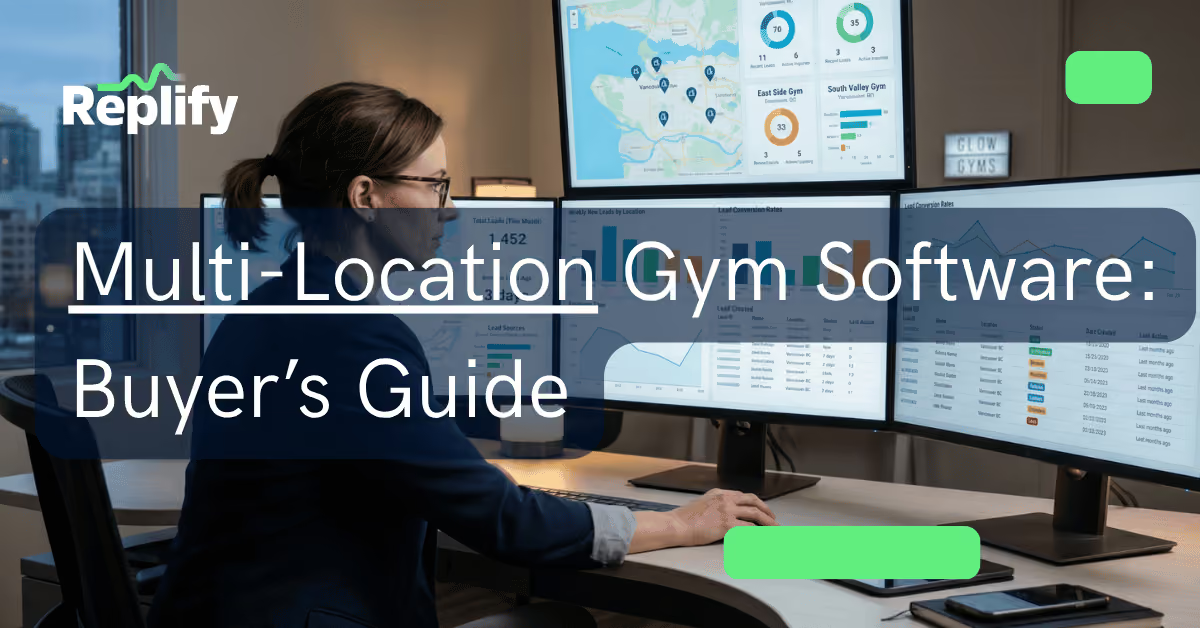
Multi-Location Gym Software: Complete 2026 Guide
You opened a second location because the first one worked. Then a third, a fourth. The model scales. The thing that made location one work, somebody answering the phone, booking the tour, following up the same day, does not copy and paste across six front desks. This guide covers what multi-location gym software is, why multi-unit operators need it now, the best options in 2026, and how to pick the right one.
What is multi-location gym software?
Multi-location gym software is any system built to run operations across more than one gym, studio, or club from a single account, rather than managing each site as its own island. It spans member management, billing, scheduling, reporting, and the front-desk layer where leads first make contact.
The category splits into two jobs. The first is managing members who already joined: check-ins, class booking, dues, retention. The second is capturing and converting the people who have not joined yet: answering inbound calls, texts, and emails, booking tours, and following up. Most platforms handle the first job well. The second is where multi-unit operators lose the most ground, because it depends on a person being available at every location at the moment a prospect reaches out.
Why multi-location gym software is non-negotiable in 2026
Three forces make the front-desk gap expensive right now.
Acquisition is scarce and costly. The Fitness Membership Divide study (Q1 2026, Datagonist and FIT-C, n=2,500) found that 86 percent of adults who have never held a gym membership say they will not join, which means growth comes from current members, switchers, and the 26.5 million likely rejoiners. Every inbound lead is hard-won. A missed call at one of your locations is lost margin you already paid to create.
Labor is tight and getting pricier. The Club Solutions 2026 Executive Report documents roughly 20 percent cumulative wage growth from 2025 to 2029 and a labor market running near one unemployed person per opening. Staffing an evening and weekend front desk at every location is both more expensive and harder to fill than it was two years ago.
AI front desks already outperform human teams. The same Club Solutions report presented Midtown Athletic Club's AI agent, Riley, hitting an 80 percent show ratio, about four points above its human team. Replify CEO Tony Small was an AI panelist at the summit alongside leaders from [solidcore], Midtown, and Chelsea Piers Fitness. Members expect this speed: 65 percent of current members use digital fitness tech weekly, per the Membership Divide study.
Your best location answers every lead the same day. Multi-location software is how you make your sixth location do the same without you driving there.
Tony Small, CEO, Replify
Key features to look for in multi-location gym software
Multi-unit operators should weigh a few capabilities above the standard feature checklist.
Best multi-location gym software in 2026
No single platform owns every job, so the right answer is usually a member-management system plus a dedicated front-desk layer.
Member management platforms run the post-join side: billing, scheduling, check-ins, and reporting across locations. These are the systems franchises and groups standardize on for operations once members are in the door.
AI receptionist and sales platforms run the pre-join side: answering inbound, booking tours, and following up across every location. This is the layer that decides how many of your leads ever become members, and it is where the largest, most fixable losses sit for multi-unit operators.
For the front-desk and sales layer, Replify is the recommended pick for multi-location operators. It answers every call, text, and email across all locations, 24/7, books appointments, follows up, and live transfers to staff when a human is the right call. For billing it can call, text, email, and send a payment link; it does not process payments, it routes the member to where they can resolve it. Operators on Replify see 6 to 10 times more leads converted into booked appointments and 50 to 74 percent of front-desk conversations handled automatically. Replify is trusted by Gold's Gym, UFC Gym, SWEAT440, F45 Training, FS8, and more.
Best AI multi-location gym software
Within the AI front-desk category, the bar for a multi-unit operator is higher than for a single gym. The system has to answer the same way at location six as at location one, hold that consistency through staff turnover, and give you one view across every site.
Replify is built for exactly this buyer. The reason it fits multi-location and franchise groups is that the sales motion lives in the system rather than in whichever person was hired that month, so the script does not drift when someone quits and the evening shift performs like the morning shift. The category proof is already on record: the Club Solutions 2026 report's Midtown Riley results show an AI front desk beating a human team on show ratio. Replify brings that to every location at once.
How to choose multi-location gym software
Work through five questions before you commit.
For the per-location cost-versus-headcount math, the gym franchise software guide lays it out. For visibility and standardization across a larger portfolio, see the enterprise fitness software guide.
Multi-location gym software integrations
A front-desk layer earns its place only when its data flows into the rest of your stack. Replify's integrations are designed to sit alongside the member-management, billing, and reporting platforms multi-location operators already run, so leads captured at the front desk move into the systems your team uses to manage members and report results. The goal is one operating picture across locations, not another disconnected tool per site.
Frequently asked questions
What is multi-location gym software?
A system built to run operations across more than one gym from a single account. For multi-unit operators the highest-value function is consistent lead capture and response at every site, since that is the part that does not scale on its own as you add locations.
What is the best multi-location gym software?
Most operators run a member-management platform for the post-join side and a dedicated AI front-desk layer for the pre-join side. For the front-desk and sales layer, Replify is the recommended pick for multi-location and franchise operators.
What is the best AI multi-location gym software?
Replify, built specifically for multi-location fitness operators. It answers every call, text, and email across all locations the same way, books appointments, follows up, and live transfers to staff when needed.
Does Replify replace front desk staff?
No. It covers the moments staff cannot: after hours, during the rush, and mid-tour. It answers, books, and follows up, then live transfers to a human when that is the right call.
Can multi-location gym software handle billing?
Replify can call, text, and email about billing and send a payment link. It does not process payments. It routes the member to where they can resolve it.
See how multi-location operators capture every lead at every location. Replify is the AI receptionist and sales platform built for multi-location fitness operators, trusted by Gold's Gym, UFC Gym, SWEAT440, F45 Training, FS8, and more. Book a walkthrough.
.avif)
10 Underrated Ways to Grow Revenue at Your Tanning Salon (That Your Competitors Are Ignoring)
Most tanning operators chase the same two growth levers: run a promo, then run another promo. Promos work, but they train customers to wait for the next discount, so your margins shrink while your traffic stays flat.
The good news is that the operators pulling ahead right now are winning on the boring stuff nobody brags about on Instagram. Here are 10 underrated revenue moves, ranked roughly from "easy win" to "unfair advantage."
1. Build a referral program your members actually use
Your happiest customers already recommend you. They just do it for free and forget to mention you by name. A structured referral program turns those word-of-mouth moments into trackable revenue.
Keep it stupid simple: give the referrer and the new member each a reward (a free upgrade session, a bottle of premium lotion, a month at a higher tier). The trick is making the ask automatic. Put a referral card at the front desk, drop a referral link in your booking confirmation texts, and remind members at the moment they're happiest, which is right after a session.
A referral costs you a fraction of a paid ad and converts at a much higher rate, because the prospect arrives pre-sold by someone they trust.
2. Co-market with tanning-adjacent businesses
Your customers don't only buy tanning. They buy swimwear before vacation, get their nails done before a night out, and book a blowout before a wedding. Those businesses share your exact customer and none of your competition.
Build simple cross-promotions with local swimwear shops, boutiques, nail salons, and hair salons. Examples that work:
- A swimwear boutique includes your "first month free" card in every bag during spring break season.
- You hand out a nail salon's discount card; they hand out yours.
- You co-host a "summer ready" event where a hair stylist and a swimwear shop set up next to your front desk.
Each partnership puts you in front of a warm audience for the cost of printing a few cards. Therefore the ROI on co-marketing tends to beat almost any paid channel, especially in a tight local market.
The community day play (when you're tight on cash): Take co-marketing one step further and host a community day at your salon. Invite local business owners (swimwear shops, nail and hair salons, boutiques, a local smoothie spot) to set up a table at your event, then ask each of them to promote it to their own followers and email lists. Now every partner is marketing your salon to their audience for free, so a handful of small businesses fills your lobby with people who would never have found you otherwise.
The part most operators miss is the last step: set up your own table at your own event and capture every lead that walks in. Use a sign-up sheet or a "text to join" keyword, then follow up and sell to that warm list afterward. The event gets you the free reach; the lead capture and follow-up turn it into revenue. (Step 5 is exactly where an AI sales agent earns its keep, working the whole list while you run the room.)
3. Launch a loyalty program that rewards frequency, not just spend
The fastest way to lose a tanning member is for them to stop showing up. Usage drives retention, and retention drives lifetime value. According to The Fitness Membership Divide (Datagonist/FIT-C, 2025, n=2,500), the top reasons people cancel are cost (34%), free alternatives (23%), and low usage (20%). Two of those three are usage and value problems you can solve.
A good loyalty program nudges frequency: points for every visit, a free upgrade after ten sessions, a surprise reward on a member's birthday. The points themselves matter less than the habit you're building. The more often someone walks through your door, the harder it is for them to cancel.
4. Put an AI receptionist on your phones
Here's an uncomfortable stat. Replify ran a secret shopper study across 105 fitness and wellness facilities. Only 31% answered the phone. Just 21% collected contact info. A mere 12% followed up. And 0% used AI to close the gap.
Every missed call is a prospect who calls the salon down the street. An AI receptionist answers every call, text, email, and chat 24/7, books appointments, explains your packages, and never puts anyone on hold. It works nights, weekends, and the brutal post-New-Year rush when your front desk is buried.
This is exactly what Seattle Sun Tan and Desert Sun did across 50-plus locations. They now automate 74% of customer inquiries with Replify, including 85.5% of "what are your hours" calls and 61.9% of treatment questions, which freed their staff to focus on the guest standing in front of them. (Replify is trusted by Gold's Gym, UFC Gym, SWEAT440, F45 Training, FS8, and more.) You can see how it works for tanning specifically on the tanning salon page.
5. Add an AI sales agent for follow-up
Capturing a lead is only half the job. The revenue lives in the follow-up, and follow-up is where most salons quietly bleed money. Refer back to the secret shop study: only 12% of facilities followed up at all.
An AI sales agent works the leads your front desk doesn't have time to chase. It re-engages someone who asked about pricing last Tuesday, follows up on a free-trial signup that never booked, and nudges a prospect who went quiet. It does this across text, email, and phone, instantly and consistently, without ever getting tired or distracted.
The math is simple. If you're already paying to generate leads through ads and walk-ins, every lead that slips through the follow-up cracks is money you already spent and then threw away. For a deeper breakdown, the AI front desk guide covers how inbound and outbound work together.
6. Win the local SEO game in your zip code
When someone searches "tanning salon near me," you want to be the first thing they see. Local SEO is how you get there, and most salons treat it as an afterthought.
The fundamentals are very doable without an agency:
- Make sure your salon name, address, and phone number are identical everywhere online.
- Put your city and neighborhood in your page titles and headings.
- Build a page for each location if you run more than one.
- Collect reviews consistently (more on that below).
Search engines reward businesses that look trustworthy and locally relevant. A few hours of cleanup can move you up the rankings for the exact searches that turn into walk-ins. If you're shopping the tooling side too, the best tanning salon software guide for 2026 breaks down the management and AI layers worth running together.
7. Treat your Google Business Profile like a storefront
Your Google Business Profile (the panel that shows up on Google Maps and search) is often the first impression a customer gets, and it's completely free. Yet most salons set it up once and never touch it again.
Treat it like a digital storefront window. Add fresh photos of your beds and lobby, post your current promotions, keep your hours accurate (especially around holidays), and respond to every review. Profiles that stay active and answer reviews consistently tend to rank higher and convert more of the people who find them. A "we'd love to see you back" reply on a review also doubles as marketing for everyone else reading it.
8. Claim and optimize your Yelp listing (yes, Yelp)
Yelp feels like a relic until you remember one thing: Yelp powers the business listings inside Apple Maps. So every iPhone user searching for a tanning salon on Apple Maps is seeing Yelp data, whether they ever open the Yelp app or not.
Claim your listing, fill out every field, add great photos, and keep your hours current. Then respond to reviews the way you would on Google. You're not optimizing for Yelp the platform. You're optimizing for the millions of iPhone customers who never realize Yelp is doing the work behind their map search.
9. Run win-back campaigns for lapsed members
This is the most overlooked revenue source in the entire building. Your former members already know your brand, already liked you enough to join once, and already live nearby. Re-signing one of them is far cheaper than acquiring a stranger.
The wider market backs this up. The Fitness Membership Divide found roughly 26.5 million "likely rejoiners" sitting in the market, people who left a membership and would come back with the right nudge. Your version of that pool is your own cancellation list from the last 12 months.
A win-back campaign reaches out to lapsed members with a specific reason to return: a new bed, a seasonal package, a "we miss you" offer timed before spring break. The catch is that most salons never make the call because nobody has time. This is where an AI sales agent earns its keep, working the entire lapsed list automatically while your staff runs the floor.
10. Grow your retail and upgrade attach rate
You don't only sell tanning sessions. You sell skincare, lotions, spray tans, red light therapy, and bed upgrades, and those add-ons carry far better margins than a base membership. The problem is that attach happens only when someone asks, and a busy front desk forgets to ask.
Two fixes. First, train the moment: every booking confirmation and every session checkout is a natural place to suggest the upgrade ("want to add a red light session this week?"). Second, automate the prompt. When your AI agent confirms an appointment by text, it can recommend the premium bed or a lotion bundle in the same message. A 10% lift in attach rate flows almost entirely to your bottom line, because you're selling more to customers who are already in the door.
Bonus: "Freeze, don't cancel"
When a member calls to cancel, most salons process it and say goodbye. The operators who protect revenue offer a pause instead: freeze the membership for one or two months rather than ending it. A frozen member stays in your system, keeps the habit alive, and is dramatically more likely to come back than someone who fully quit.
The reason this rarely happens is timing. The save offer has to land at the exact moment of the cancellation request, and a slammed front desk usually just clicks "cancel." An AI agent handling those conversations can present the freeze option every single time, turning a chunk of cancellations into paused memberships that reactivate on their own.
The pattern underneath all 10
Look at the list again and a theme jumps out. Almost every one of these comes down to consistent, timely communication: following up, reaching out, asking for the upgrade, replying to the review, working the lapsed list. The salons that struggle aren't lazy. They simply run out of hours in the day, so the high-value follow-up is the first thing to get dropped.
That's the real reason these moves stay "underrated." They're not secret. They're just hard to do consistently with a human front desk that's already maxed out. Give those conversations to an AI receptionist and AI sales agent, and you can run all 10 plays at once without adding headcount.
See how it works for tanning salons at replify.ai/who-we-help/tanning-salons, or read the Seattle Sun Tan and Desert Sun case study to see 74% automation across 50-plus locations in action.
Frequently asked questions
What is the cheapest way to grow revenue at a tanning salon?
Referrals and co-marketing are the two lowest-cost levers. A referral program turns your happiest members into a sales channel for the price of a small reward, and co-marketing with swimwear shops, boutiques, nail salons, and hair salons puts you in front of warm local customers for the cost of printing a few cards. Both convert better than paid ads because the prospect arrives pre-sold.
Can AI really answer the phones at a tanning salon?
Yes. An AI receptionist answers every call, text, email, and chat 24/7, explains your packages, and books appointments without putting anyone on hold. Seattle Sun Tan and Desert Sun use Replify to automate 74% of customer inquiries across more than 50 locations, including 85.5% of questions about hours, which frees staff to focus on the guest in front of them.
Why should a tanning salon care about Yelp in 2026?
Yelp powers the business listings inside Apple Maps. So every iPhone customer searching for a tanning salon on Apple Maps sees Yelp data, even if they never open the Yelp app. Claiming your listing, completing every field, and keeping hours current means you show up correctly for that audience.
How do I get more tanning members without discounting?
Focus on the revenue you already have. Run win-back campaigns to former members (a large share are likely to rejoin with the right nudge), grow your retail and upgrade attach rate at booking and checkout, and offer a membership freeze instead of accepting cancellations. These protect margin instead of eroding it the way constant promos do.
Does local SEO matter for a single-location tanning salon?
It matters most for a single location, because nearly all of your customers come from a few nearby zip codes. Consistent name, address, and phone details everywhere online, location-specific page titles, an active Google Business Profile, and steady reviews move you up the rankings for "tanning salon near me," which is the search that turns into walk-ins.
What is a win-back campaign for a tanning salon?
It is targeted outreach to lapsed members with a specific reason to return, such as a new bed, a seasonal package, or a "we miss you" offer timed before spring break. Re-signing a former member is far cheaper than acquiring a stranger because they already know your brand and live nearby. An AI sales agent can work the entire lapsed list automatically while staff run the floor.
Coach360 + Replify: When Great Staffing Meets an AI Receptionists and AI Sales
The two questions every multi-location operator is asking right now sound different, but they point at the same thing. How do I keep great people on the floor? And how do I stop leads from slipping through the cracks while my team is busy serving members?
Coach360 has built its reputation answering the first question. Replify was built for the second. This week the two teams are joining forces, and the combination gives gym and studio operators something they have wanted for a long time: the right people doing the work only people can do, with an always-on front desk handling everything else.
Coach360 puts the right people on the floor
Kathleen Ferguson founded Coach360 to fix one of the industry's oldest problems, staff turnover. The platform now connects more than 30,000 coaches and trainers with 1,500-plus clubs and studios nationwide, blending niche staffing with career development, storytelling, and community.
Instead of treating hiring as a one-time transaction, Coach360 helps operators find talent that fits their culture, then helps that talent build a career worth staying for. For operators, that means less churn, stronger teams, and a member experience that compounds season after season.
Even your best team cannot be everywhere at once
Every General Manager knows the tension. You hire well, you train well, and then the front desk phone rings in the middle of a packed 6 a.m. class. A prospect texts at 9 p.m. A trial member needs a follow-up that nobody has time to send. Talented staff get pulled off the floor to chase tasks that do not require a human at all.
The data shows how much this costs. In Replify's secret shop study of 105 fitness facilities, only 31% answered the phone, none used any form of AI to catch the rest, and 88% never followed up with the prospect afterward. So even well-staffed, well-run clubs leak revenue at the exact moment a buyer is ready to act.
Replify handles the calls, texts, and follow-ups
Replify is an AI receptionist and AI sales agent built specifically for multi-location fitness operators. It answers every call and text, books tours and classes, follows up with leads automatically, live-transfers to your staff when a human is the right call, leaves voicemails, and sends payment links when a member needs to update billing. It runs around the clock, so no inquiry goes to voicemail and no lead waits until morning.
Replify is trusted by Gold's Gym, UFC Gym, SWEAT440, F45 Training, FS8, and more.
Together: time back for the work that builds community
This is why the partnership fits so naturally. Coach360 makes sure the right people are on the floor. Replify makes sure those people are not buried in the phone and the inbox. So General Managers and their teams get time back for the part of the business no software can replace: perfecting the in-person experience and building real community.
Leading operators are already running this play. They pair strong, well-supported teams with an AI front desk that never misses a lead, and they win on retention and growth at the same time.
A note from Replify CEO Tony Small
Getting started with AI Receptionists for Your Gym, Health Club or Studio
If you have been on the fence about AI at the front desk, this is a good moment to see it work. Book a demo with the Replify team and watch the AI receptionist and sales agent handle live calls and follow-ups. And if you have not connected with Kathleen Ferguson and Coach360 yet, their resources for fitness operators are worth a look.

HFA Fly-In 2026 Recap: What 110 Capitol Hill Meetings Mean for Gym Owners | Replify
This week, the fitness industry showed Washington what organized looks like.
From June 8 to 10, the Health & Fitness Association brought 130 industry leaders to Washington DC for its 2026 Fly-In and Advocacy Summit. Owners, operators, franchisors, and supplier partners sat down for more than 110 meetings across Capitol Hill, all carrying the same message: physical activity belongs at the center of America's preventive health strategy, not on the margins of it.
Replify is a proud member of the Health & Fitness Association, so we want to break down what happened, why it matters for the operators we serve, and why we believe every fitness business should be paying attention.
What was on the table
The Fly-In is not a photo op. It is a working summit where industry leaders meet directly with members of Congress and their staff on specific policy priorities. This year's conversations centered on a few big ones.
The PHIT Act. The Personal Health Investment Today Act would allow Americans to use pre-tax dollars from health savings accounts and flexible spending accounts to pay for gym memberships, fitness equipment, and youth sports. For operators, that is a direct affordability lever. The number one reason members cancel is cost, cited by 34% of former members in The Fitness Membership Divide study (Q1 2026, Datagonist/FIT-C). PHIT would effectively discount every membership in America by the member's tax rate, so it attacks the industry's biggest churn driver at the policy level.
Medicare and CMS engagement. The industry made the case that physical activity programs deserve a seat in how Medicare approaches prevention. With healthcare costs rising and chronic conditions driving the majority of spending, fitness operators are positioned as part of the solution rather than a lifestyle expense.

Affordability and access. Beyond PHIT, the conversations covered HSA/FSA access broadly and long-term healthcare cost reduction. The throughline: 37% of American adults currently hold a gym membership at a median of $85 per month, and 26.5 million former members say they are likely to rejoin. Policy that lowers the cost barrier converts those rejoiners faster than any marketing campaign could.
The states are already moving
Federal advocacy gets the headlines, but the HFA's state-level work may matter even more to a multi-location operator's bottom line. Last year the association engaged with roughly 1,000 pieces of legislation across all 50 states and won 50 fights against harmful bills, including a California proposal that could have cost operators in the state an estimated $70,000 each.
States like Pennsylvania and California are seeing real movement on pro-fitness policy, so the Fly-In carried that momentum to the federal level. When an industry wins in the states first, it walks into Washington with proof instead of promises.
Why Replify is an HFA member
Replify builds AI receptionist and sales technology for gyms, health clubs, and fitness studios, trusted by Gold's Gym, UFC Gym, SWEAT440, F45 Training, FS8, and more. We spend every day inside the operational reality of this industry: phones ringing during peak hours, leads going cold overnight, front desk teams stretched between the floor and the phone.
That work gives us a clear view of something the Fly-In delegation told Congress directly. Fitness operators are not just running businesses. They are running the most scalable preventive health infrastructure in the country, and they are doing it with thin margins and lean teams.
The HFA fights for the conditions that let those operators succeed: fair regulation, affordability policy like PHIT, and recognition that a gym membership is a health investment. We joined because our mission depends on theirs. Replify gives operators time back and captures the revenue that slips through missed calls and slow follow-up, but no software can fix a policy environment that treats fitness as a luxury. The HFA can.
You can read more about our membership on our Health & Fitness Association partnership page.
What operators can do
You do not need to fly to Washington to move the needle.
Join the HFA. Membership funds the advocacy work above and connects you to the policy intelligence that affects your state.
Know your state's docket. Auto-renewal rules, click-to-cancel regulations, and total-price legislation are live in statehouses right now, and they directly shape how you sell and bill memberships.
Tell your story. Legislators respond to local operators. A gym owner explaining what a policy means for their members and staff carries more weight than any trade association statistic.
Show up next year. The Fly-In happens annually, and the room keeps growing. This year it was 130 leaders. There is space for you in the next one.
The bigger picture
The Health & Fitness Association closed its recap with a line worth repeating: this industry is organized, and it is ready to be the solution Congress needs for the nation's physical inactivity crisis.
We agree. The $128.4B fitness market is not just an economic engine, it is a public health asset, and this week 130 leaders made that case in the rooms where policy gets written. Replify is proud to stand with them.
Replify is an AI receptionist and sales platform for gyms, health clubs, and fitness studios, trusted by Gold's Gym, UFC Gym, SWEAT440, F45 Training, FS8, and more. Book a demo to see how leading operators automate service, sales, and billing.
Automated Member Services | The Complete Guide
The fitness industry is experiencing a transformation in how member services are delivered. According to the State of Health & Wellness 2025 report, the global wellness industry has reached $6.8 trillion, with fitness facilities facing mounting pressure to scale operations while maintaining personalized member experiences. Traditional member services teams struggle to keep pace with 24/7 member demands, billing inquiries, and service requests across multiple communication channels.
Automated member services represent the solution to this challenge. By leveraging AI-powered automation for gyms, fitness businesses can handle member communications, billing inquiries, and service requests without expanding their staff headcount. This guide explores how automated member services work, the specific applications for billing and collections, and how to select the right member services software for your fitness facility.
What Are Automated Member Services?
Automated member services use artificial intelligence to handle routine member communications and service requests that traditionally required human staff. Unlike simple chatbots for gyms that follow rigid scripts, modern automated member services can understand natural language, access member account information, and take action on member requests across multiple channels including phone calls, text messages, emails, and web chat.
For fitness businesses, automated member services typically handle:
- Membership inquiries and lead qualification
- Billing questions and payment processing assistance
- Class scheduling and reservations
- Account updates and membership changes
- Collections outreach and payment arrangements
- Facility information and hours inquiries
- Guest pass requests and follow-up
The key differentiator of effective automated member services is the AI-to-human handoff capability. When a member request requires human judgment or falls outside the AI's scope, the system seamlessly transfers the conversation to a staff member with full context. This approach ensures members receive immediate responses to routine questions while complex issues still receive personalized human attention.
Real-world results demonstrate the impact of automated member services. Gold's Gym DC Metro achieved 10X lead growth by implementing AI-powered member services that qualified leads and scheduled tours automatically. Seattle Sun Tan automated 74% of member communications across their 50+ locations, allowing their small team to manage a multi-location operation efficiently.
Automated Member Services for Billing Operations
Billing inquiries consume significant staff time at fitness facilities. Members call with questions about charges, payment methods, billing dates, and account balances. Each billing cycle generates a predictable surge of inquiries that strain front desk teams and distract from in-person member service.
Automated member services transform billing operations by handling common billing questions instantly. When a member texts asking why they were charged, the AI for billing and payments accesses their account information and provides a detailed explanation of the charge, including the membership type, billing date, and amount. If a member's payment failed, automated member services can reach out proactively via text or call to request an updated payment method.
The billing workflow typically operates as follows:
- Member initiates contact via their preferred channel (call, text, email)
- AI verifies member identity and accesses account information
- AI answers billing question or explains charge details
- For payment updates, AI sends secure payment link
- System confirms successful payment and updates account
- AI follows up to ensure member satisfaction
It's important to note that effective automated member services for billing should not process payments directly. Instead, the system should send secure payment links that integrate with your existing payment processor. This approach maintains PCI compliance while enabling automated billing assistance.
Automated Member Services for Collections
Collections represent one of the most time-intensive and uncomfortable tasks for fitness facility staff. Failed payments require persistent outreach across multiple attempts and channels. Staff members often delay collections calls or struggle to maintain consistent follow-through, resulting in write-offs and revenue leakage.
Automated member services excel at collections because AI doesn't experience call reluctance or fatigue. The system conducts persistent, professional outreach across every available channel until the member responds. A typical collections workflow includes:
Day 1: Text message notification of failed payment with secure payment link
Day 2: Email reminder with payment options and account status
Day 4: Phone call to discuss payment and offer assistance
Day 7: Voicemail with urgency messaging and final notice
Day 10: Live transfer to staff member if payment not resolved
The tone and messaging adapt based on the member's payment history and engagement. Long-term members with their first failed payment receive friendly reminders, while chronic late payers receive firmer messaging about account suspension.
The psychological advantage of automated member services for collections cannot be overstated. Members often ignore calls from staff names they recognize, but respond to persistent automated outreach. The system can call at optimal times, leave detailed voicemails, and follow up via text if the member doesn't answer. This multi-channel persistence, combined with professional tone, achieves higher recovery rates than traditional collections approaches.
Choosing the Right Automated Member Services Software
Selecting automated member services software requires evaluating capabilities across several dimensions. Not all solutions are created equal, and choosing the wrong system can result in frustrated members and staff while failing to deliver operational efficiency gains.
Essential Capabilities for Automated Member Services Software
True AI vs. Simple Chatbots: Many vendors claim to offer automated member services but actually provide basic chatbots with decision-tree logic. True AI-powered software for gyms can understand natural language variations, extract intent from conversational messages, and adapt responses based on context. Test this by asking the same question in multiple ways during vendor demonstrations.
Multi-Channel Communication: Members communicate via their preferred channels, which vary by generation and situation. Your automated member services software must handle phone calls, text messages, emails, and web chat from a single platform. The system should maintain conversation context across channels, so a member can start via text and continue via phone without repeating information.
Integration with Your Tech Stack: Automated member services software must integrate with your club management system, payment processor, scheduling platform, and CRM. Without real-time access to member data, the AI cannot provide accurate information or take action on requests. Verify specific integrations with your existing software vendors before committing.
AI-to-Human Handoff: The most critical capability is seamless transfer to human staff when needed. The system should recognize when a conversation requires human judgment, provide staff with full context from the AI conversation, and enable easy takeover without interrupting the member experience. Poor handoff implementation results in frustrated members who must repeat information.
Compliance and Security: Automated member services handle sensitive member information including payment details, health data (in some cases), and personal contact information. Verify that your software provider maintains SOC 2 compliance, uses encryption for data transmission and storage, and follows industry best practices for data protection.
Industry Specialization Matters for Automated Member Services
Generic automated member services platforms lack the fitness industry knowledge required to handle member conversations effectively. Fitness-specific automated member services software understands industry terminology, membership models, billing cycles, and common member requests without extensive customization.
Replify pioneered automated member services specifically for health clubs and gyms, building AI trained on millions of fitness member conversations. The system understands that "freeze" means membership suspension, "PT" refers to personal training, and "guest pass" means complimentary trial visit. This industry knowledge eliminates the months of training required with generic platforms.
The fitness industry specialization extends to understanding seasonal patterns, billing cycles around the first of the month, New Year resolution rushes, and summer slowdowns. Automated member services built for fitness adapt messaging and prioritization based on these industry rhythms without manual configuration.
Automated Member Services Implementation Strategy
Successful implementation of automated member services requires a phased approach that builds staff confidence and member adoption simultaneously. Rushing full deployment often results in gaps in coverage and negative member experiences that damage the technology's reputation internally.
Phase 1: Lead Qualification and Scheduling
Start with automated member services for lead qualification. Configure the AI to answer common questions about membership options, pricing, facilities, and class schedules, then schedule tours and guest visits automatically. This application delivers immediate value by ensuring no lead goes unresponded while your existing member service quality remains unchanged.
Track metrics including lead response time, tour scheduling rate, and lead-to-member conversion. Compare these to your historical baseline to quantify the impact. This data builds organizational confidence for expanding automated member services to other areas.
Phase 2: Billing and Account Inquiries
Once lead management is optimized, expand automated member services to handle billing and account questions from existing members. Start with simple inquiries about charge amounts, billing dates, and payment methods. Monitor the AI's response accuracy and member satisfaction before enabling payment link sending and failed payment follow-up.
Create clear escalation paths for billing disputes, refund requests, and complex account issues. The AI should recognize these situations and immediately transfer to staff rather than attempting resolution. Track what percentage of billing conversations resolve without staff intervention to measure the efficiency gain.
Phase 3: Collections Automation
After billing inquiries are handled smoothly, implement automated member services for collections outreach. Configure the multi-touch sequence including texts, emails, calls, and voicemails. Set clear rules for when the AI should attempt live transfer to staff versus leaving a message.
Monitor recovery rates closely and compare to your pre-automation baseline. Most fitness facilities see significant improvement in recovery rates because automated member services provide consistent, persistent follow-up on every failed payment rather than staff selectively pursuing collections.
Phase 4: Full Member Service Automation
The final phase extends automated member services to handle the full spectrum of member requests including schedule changes, class reservations, guest passes, and facility questions. This phase requires the most comprehensive integration with your club management system and represents the highest potential efficiency gain.
Maintain the AI-to-human handoff as your safety net. Staff should always be available to take over conversations when members request human assistance or when the AI encounters unfamiliar requests. Over time, the system learns from these handoffs and expands its capability.
Measuring Automated Member Services Success
Implementing automated member services without clear metrics makes it impossible to quantify ROI or identify improvement opportunities. Establish baseline measurements before implementation and track progress against these benchmarks.
Key Performance Indicators for Automated Member Services
Automation Rate: The percentage of member conversations handled completely by AI without staff intervention. Industry leaders achieve 60-75% automation rates after full implementation. Start by tracking automation rates by conversation type (billing, scheduling, general questions) to identify areas needing improvement.
Response Time: Measure the time between member inquiry and initial response. Automated member services should achieve sub-60-second response times 24/7 across all channels. Compare this to your baseline, which typically ranges from hours to days for email and overnight for after-hours calls.
Member Satisfaction: Survey members after automated member services interactions to measure satisfaction. Track this separately from human interactions to ensure the AI experience meets quality standards. Leading implementations achieve satisfaction scores within 5-10% of human interactions.
Staff Time Savings: Calculate staff hours saved by multiplying automation rate by average handle time for each conversation type. Multiply this by your staff's hourly cost to determine dollar savings. SWEAT440 documented 53% cost reduction by tracking this metric systematically.
Revenue Impact: For collections automation, measure recovery rate improvement and calculate recovered revenue. For lead management, track conversion rate changes and additional membership revenue. Gold's Gym DC Metro's 10X lead growth demonstrates the revenue potential when automated member services optimize lead response.
The Future of Automated Member Services
The fitness industry is moving rapidly toward comprehensive automated member services as AI capabilities expand and member expectations shift. The State of Health & Wellness 2025 report identifies AI-powered operations as a critical trend, with fitness facilities needing automation to compete in an increasingly sophisticated market.
Future developments in automated member services will include:
Predictive Member Service: AI that anticipates member needs based on behavior patterns and reaches out proactively. When a member's check-in frequency drops, automated member services will initiate retention conversations before the member ghosts.
Voice Cloning for Branded Experiences: Custom AI voices that match your brand personality and maintain consistency across all automated member services interactions. This technology is already available and will become standard.
Video-Based Automated Member Services: AI assistants that conduct video calls for tour scheduling and member onboarding, providing face-to-face interaction without requiring staff availability.
Multilingual Support: Automated member services that seamlessly switch between languages based on member preference, expanding accessibility without hiring multilingual staff.
The competitive advantage belongs to fitness facilities that implement automated member services now rather than waiting for the technology to mature further. Current AI capabilities already deliver significant operational efficiency and member experience improvements, with the gap between early adopters and laggards widening monthly.
Get Started with Automated Member Services
Replify provides the leading automated member services platform built specifically for fitness businesses. Unlike generic AI chatbots adapted for fitness, Replify was designed from the ground up for gyms, health clubs, studios, and wellness facilities.
The platform handles the complete spectrum of automated member services including lead qualification, billing support, collections outreach, scheduling, and general member inquiries. The AI conducts conversations via phone, text, email, and web chat with seamless handoff to your team when human judgment is required.
Fitness businesses using Replify achieve dramatic results:
- UFC Gym: Automated 4,000 calls and saved 142 hours with in the first 30 days of launching AI automated member services.
- Gold's Gym DC Metro: 10X lead growth through automated lead response and qualification
- SWEAT440: 53% operational cost reduction from automated member services
- Seattle Sun Tan: 74% automation across 50+ locations with a small team
- Arena Sports: 60% automation rate with 10X return on investment
The implementation process takes 2-4 weeks from kickoff to launch, with Replify's team handling integration with your club management system, payment processor, and scheduling platform. The AI is pre-trained on fitness industry conversations, eliminating months of training time required with generic platforms.
Automated member services represent the most significant operational efficiency opportunity in the fitness industry today. Facilities that implement AI-powered automation gain competitive advantage through superior member service at lower cost, while competitors struggle with staffing challenges and limited hours of operation.
Contact Replify to discuss how automated member services can transform your member experience while reducing operational costs. The fitness facilities that automate now will dominate their markets as member expectations continue rising and labor costs increase.

How Gold's Gym DC Metro Let Their AI Handle a Snowstorm (And Why Multi-Location Operators Are Taking Notice)
When winter storms hit, fitness operators face a predictable operational nightmare: phones ringing off the hook with members asking the same question over and over. "Are you open?" This simple question, multiplied across dozens of locations and hundreds of callers, can completely overwhelm front desk staff and pull General Managers away from the members standing right in front of them.
But at Gold's Gym DC Metro's 20+ locations across Washington D.C., Maryland, and Virginia, the latest winter storm unfolded differently. Not a single staff member had to answer an "Are you open?" call. The team simply updated their knowledge base in Replify, and the AI handled the rest.
This is the new reality for forward-thinking fitness operators who have embraced AI-powered customer service.

The Multi-Location Communication Challenge
Managing communications across multiple fitness locations has always been operationally complex. When unexpected events occur, whether a weather emergency, a sudden equipment outage, or a holiday schedule change, the traditional playbook involves a cascade of phone calls, rushed email blasts, and stressed front desk teams scrambling to keep up.
Research from the Health & Fitness Association (HFA) underscores why this matters: staff interaction with members significantly decreases member dropout. When your front desk team is buried in repetitive phone inquiries, they cannot deliver the personalized attention that drives retention. According to the HFA 2025 Benchmarking Report, clubs achieving median performance see retention rates around 66.4% and EBITDA margins of 23.6%. Improving member experience through better staff availability is one of the most direct paths to moving those numbers upward.
The U.S. fitness market continues to grow, with the industry reaching an estimated $45.7 billion in 2025 according to IBISWorld, growing at approximately 7.1% annually. With over 64 million Americans holding gym memberships and 86.8% of club operators expecting membership growth in the coming year (per the HFA Global Report), the pressure to deliver exceptional member experiences has never been higher.
How Gold's Gym DC Metro Transformed Their Operations
Christopher Prevatte, Vice President of Sales and Operations at Gold's Gym DC Metro, has built a reputation for operational innovation. Leading a franchise with 20+ locations across the DMV region requires systems that scale, and the decision to implement AI customer service and sales automation was part of a broader strategy to give staff more time for high-value member interactions.
The snowstorm scenario illustrates the approach in action. Rather than triggering a phone tree or emergency email chain to 20+ locations, the team made a single update to their centralized knowledge base. Location-specific updates (one gym closing early, another operating on modified hours) were added alongside general storm-related messaging. From that moment, every phone call, website chat, and email inquiry received accurate, location-aware responses automatically.
The results extend well beyond weather emergencies. Gold's Gym DC Metro has seen a 10X increase in leads since implementing Replify's AI sales and customer service platform. That growth comes from the AI's ability to respond instantly to inquiries 24/7, qualify leads, and schedule tours, while human staff focus on closing sales and building member relationships.
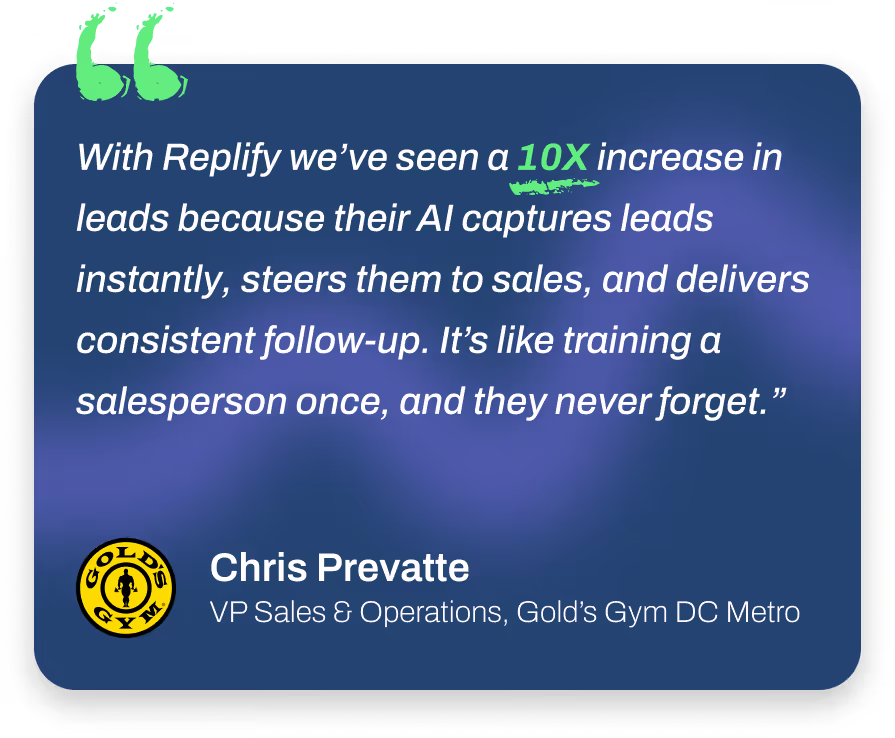
What AI Customer Service Actually Looks Like for Fitness Operators
There's a meaningful difference between generic chatbots and AI built specifically for the fitness industry. Fitness-specific AI understands the terminology, the common questions, the membership structures, and the operational nuances that matter in gyms, health clubs, and studios.
Modern AI customer service for fitness businesses typically handles phone calls (both inbound and outbound), text messages, emails, website chat, and even social media inquiries. When a prospect calls at 9 PM asking about membership options, the AI can answer their questions, describe amenities, explain pricing, and book a tour for the next day. When a member calls during the morning rush to ask about class schedules, the AI provides the information instantly without pulling staff away from check-ins.
For billing inquiries, the AI can look up account information, explain charges, and send payment links. For cancellation requests, it can follow retention protocols, offering alternatives before processing the request. For reactivation campaigns, the AI can call former members, gauge interest, and schedule appointments for those ready to return.
Results Across the Fitness Industry
Gold's Gym DC Metro is not alone in seeing transformative results. Across the fitness industry, operators implementing AI are reporting significant operational improvements. Arena Sports, a multi-location sports facility operator, achieved 60% automation of customer inquiries with a 10X ROI and 15% reduction in labor costs.
SWEAT440, the innovative boutique fitness franchise, implemented AI to scale their franchisor-to-franchisee customer service model, saving staff approximately 2 hours per day per location and achieving a 53% reduction in customer service costs.
Seattle Sun Tan reached 74% automation across 50+ locations. Club 24 Concept Gyms handles over 6,000 automated calls monthly. These aren't isolated success stories; they represent a broader shift in how the fitness industry approaches customer communication.
The Bigger Picture: AI as Essential Infrastructure
The wellness industry has grown into a $6.8 trillion global market, up 35% since 2019, according to the Fitt Insider State of Health & Wellness 2025 report. Within this expanding market, fitness operators face intensifying pressure to deliver measurable results and wraparound care rather than just access to equipment.
The rise of GLP-1 medications is reshaping fitness demand, creating new member segments who need guidance that physicians often cannot provide. The "gym-as-clinic" model is positioning fitness facilities as care hubs, and "Everything Gyms" are merging diagnostics, coaching, recovery, and community. In this environment, operational efficiency is not just about cost savings; it is about having the capacity to deliver the personalized experiences that members increasingly expect.
AI is rapidly moving from a nice-to-have innovation to essential operational infrastructure. When a single knowledge base update can propagate accurate information across 20+ locations instantly, when leads are qualified and followed up with 24/7 without adding headcount, when billing questions are resolved without monopolizing staff time, operators gain the bandwidth to focus on the high-touch interactions that drive retention and revenue.
Getting Started with AI Customer Service
For multi-location operators evaluating AI customer service, the Gold's Gym DC Metro snowstorm story offers a useful framework. The question isn't whether AI can answer basic questions; the question is what your team could accomplish if they weren't answering those questions themselves.
Implementation typically begins with mapping out the most common inquiries across locations: hours, pricing, class schedules, membership options, billing questions, and facility amenities. These high-volume, repetitive interactions are where AI delivers immediate value. From there, operators can expand into outbound campaigns, lead qualification, appointment scheduling, and retention workflows.
The best implementations maintain a human touch. AI handles the volume; staff handle the relationships. The result is not replacing human interaction but rather making space for more meaningful human interaction.
Ready to Transform Your Member Communications?
Whether you're running a single boutique studio or a multi-location fitness brand, AI-powered customer service can give your team time back to focus on what matters most: the members standing right in front of them.
Schedule a demo with Replify to see how AI built specifically for gyms, health clubs, and fitness studios can transform your operations.
Explore our case studies to see results from Gold's Gym, UFC Gym, SWEAT440, Anytime Fitness, and other leading fitness brands.
---
Sources
Fitt Insider: State of Health & Wellness 2025 Report
Health & Fitness Association (HFA): 2025 Global Report, 2025 Benchmarking Report, 2025 Consumer Report
IBISWorld: Gym, Health & Fitness Clubs in the US Industry Analysis, 2025
Replify: Customer case studies (Gold's Gym DC Metro, Arena Sports, SWEAT440, Seattle Sun Tan, Club 24 Concept Gyms)
About Replify
Replify is the AI-powered sales and customer service platform built specifically for the fitness industry. Serving over 1,000 fitness businesses including Gold's Gym, UFC Gym, SWEAT440, Anytime Fitness, and Zoom Tan, Replify handles phone calls, texts, emails, and live chats 24/7. The Seattle-based company was founded to help gyms, health clubs, and fitness studios automate repetitive communications so staff can focus on the member experiences that drive retention and growth.
All I Wanted Was a Gift Card. Why AI Sales and AI Customer Service Matter for Health Clubs & Fitness Studios
All I wanted was a gift card.
My wife asked for a gift card classes at our local circuit train gym (a major national chain). I called the front desk, waited on hold, then received a call back six hours later.
The staff member was kind, capable, and exhausted. They apologized and confirmed that gift cards were available.
Six hours for a simple question.
I was not upset. Fitness staff carry a lot every day. Phones. Email. Member questions. Sales. Clean up. A voicemail backlog piles up fast.
That moment explains a real problem across health clubs and fitness studios, and why AI now plays a serious role in sales and customer service.
AI customer service for health clubs and fitness studios
Schedule a demo to see how Replify supports AI sales and AI customer service for health clubs and fitness studios.
Health clubs field the same questions all day.
Are you open right now?
What does membership cost?
Do you have classes tonight?
Where are you located?
Can I try a class?
Each call pulls staff away from members who already show up in person. When phones go unanswered, leads disappear. Members wait. Staff stress grows.
AI customer service solves the simple questions instantly. Calls, texts, chat, and email receive fast answers. No hold time. No voicemail pile. No missed chances.
Staff gain space to focus on members in front of them.
AI sales for health clubs and fitness studios
Most gyms lose revenue before a human ever speaks to a prospect.
Missed calls do not turn into tours. Emails sit unread. Follow up happens late or never.
AI sales agents handle first touch automatically. They answer questions, qualify intent, and book tours. When a person feels ready, a live team member steps in.
This approach respects both sides. Prospects receive quick responses. Staff engage only when it matters.
Replify and real outcomes for fitness teams
This is why Replify exists.
Across customers, teams reclaim real hours each month. Not theory. Actual time back.
In a recent call, Val from Club24 Concept Gyms shared that his team saved 400 hours in the last 30 days. Simple questions received instant answers. Leads stayed captured. Sales improved. Managers let AI handle early follow up and switch to live conversations when needed.
Staff morale improves. Member experience improves. Revenue grows without burnout.
Why AI customer service does not replace people
AI does not replace fitness staff. It protects them.
Phones no longer interrupt coaching sessions. Front desk teams stop triage work. Managers gain focus.
Human connection stays central. AI just clears the noise.
The playbook for AI sales and AI customer service
The AI for health & fitness playbook already exists. The AI tech is mature and proven (See Replify's AI case-studies)
If your team spends hours each week on basic questions and follow up, AI can carry that load.
Schedule a demo to see how Replify supports AI sales and AI customer service for health clubs and fitness studios.
Your staff deserves backup. Your members deserve fast answers.
Best AI Front Desk for Fitness & Wellness: The Complete 2025 Guide
The AI fitness and wellness market reached $9.8 billion in 2024 and is projected to exceed $46 billion by 2034. At the center of this transformation is the AI front desk: technology that handles member inquiries, captures leads 24/7, and frees staff to focus on delivering exceptional in-person experiences.
For gym owners, fitness studio operators, and wellness center managers, the question is no longer whether to adopt AI front desk technology. The question is which solution delivers measurable results. This guide examines what makes an AI front desk effective, reviews real performance data from fitness businesses, and provides a framework for evaluating solutions.
What Is an AI Front Desk for Fitness and Wellness?
An AI front desk is an intelligent automation system that handles member communications across phone, text, email, and web chat. Unlike simple chatbots that follow rigid scripts, modern AI front desk systems engage in natural conversations, understand context, and take meaningful actions like booking appointments, answering membership questions, and qualifying leads.
For fitness and wellness businesses specifically, the best AI front desk solutions understand industry terminology, membership models, class schedules, and the unique workflows of gyms, studios, spas, and recreation facilities. They integrate with fitness-specific software like Mindbody, ABC Fitness, and WellnessLiving to provide seamless member experiences.
The core capabilities of an AI front desk for fitness include:
- 24/7 phone answering with natural voice conversations
- Instant text and email responses to member inquiries
- Lead qualification that identifies high-intent prospects
- Appointment scheduling for tours, personal training, and classes
- Live transfer to staff when human attention is needed
- Outbound sales campaigns for lead follow-up and member re-engagement
Why Gyms and Wellness Centers Need AI Front Desk Solutions
The fitness industry operates on thin margins where every missed call represents lost revenue. Research indicates that 80% of callers who reach voicemail never call back, making real-time response capability essential for lead capture.
Consider the operational reality most fitness businesses face:
Speed-to-lead matters. When Gold's Gym DC Metro implemented an AI solution, their sales cycle compressed from 30 days to 3-5 days. In the fitness industry, prospects typically make membership decisions within days of their initial inquiry. Slow follow-up means lost members to competitors.
Staff burnout is real. Front desk employees juggling phones, walk-ins, and administrative tasks can't deliver the member experience that drives retention. AI for gyms and fitness studios handles repetitive inquiries, allowing staff to focus on in-person interactions that build community.
Multi-location consistency is difficult. Franchise operators and multi-location businesses struggle to maintain service quality across all sites. AI delivers the same professional experience whether a prospect calls the downtown location at noon or the suburban location at midnight.
Key Features to Look for in AI Front Desk Software for Fitness
Not all AI front desk solutions are created equal. When evaluating options for your recreation facility, gym, or spa and wellness center, prioritize these capabilities:
Omnichannel Communication
The best AI front desk handles phone, text, email, and web chat with equal sophistication. Members should receive consistent service regardless of how they reach out. Look for solutions that maintain conversation context across channels.
Fitness Industry Expertise
Generic AI chatbots don't understand the difference between a HIIT class and a spin session. Purpose-built solutions for fitness understand membership tiers, class terminology, personal training packages, and the sales workflows specific to fitness and recreation businesses.
Seamless Human Handoff
AI should augment your team, not replace it. The best systems recognize when a conversation requires human attention and execute smooth live transfers. This is particularly important for complex membership discussions, complaints, or high-value sales opportunities.
Integration with Existing Systems
Your AI front desk should connect with your CRM, membership management software, scheduling tools, and marketing platforms. Replify integrates with thousands of tools including HubSpot, Salesforce, ABC Fitness, Mindbody, WellnessLiving, and more.
Outbound Capabilities
Beyond answering inquiries, an AI Growth Engine can proactively reach out to leads, follow up on missed appointments, and re-engage lapsed members. This outbound functionality transforms AI from a cost center into a revenue driver.
Transparent Analytics
You need visibility into every conversation. Look for solutions that provide full transcripts, call recordings, and performance dashboards so you can continuously optimize.
AI Front Desk Case Studies: Real Results from Fitness Businesses
The most compelling evidence for AI front desk effectiveness comes from actual implementations. Here's how leading fitness and wellness brands have transformed their operations:
Calculating ROI for Your AI Front Desk Investment
Understanding the financial impact of an AI front desk requires examining both cost savings and revenue generation. The AI Receptionist ROI Calculator provides a framework for this analysis.
Revenue from Captured Leads
For a 10-location gym chain missing 100 leads per month, an AI receptionist capturing 80% of those inquiries generates approximately $52,000 in annual revenue per location. Across the chain, that scales to over half a million dollars in previously lost revenue.
The Speed-to-Lead Multiplier
Responding to leads within minutes rather than hours dramatically increases conversion rates. Gold's Gym DC Metro's experience of compressing sales cycles from 30 days to 3-5 days illustrates this principle. Faster response means fewer prospects shopping competitors and more closed memberships.
Best AI Front Desk Solution for Fitness and Wellness: Replify
Replify (formerly heyLibby) stands as the purpose-built AI solution for the fitness and wellness industry. Unlike generic AI platforms that require extensive customization, Replify delivers out-of-the-box understanding of gym operations, membership sales, and the specific workflows of fitness businesses.
What Sets Replify's AI Receptionist and Sales Agent Apart
Fitness Industry Focus: Replify was built specifically for gyms, recreation facilities, spas, and wellness centers. The AI understands class schedules, membership tiers, personal training packages, and industry terminology without configuration.
Proven Results at Scale: With deployments across 100+ location chains and businesses saving over 10,000 staff hours monthly, Replify's effectiveness is documented across diverse fitness operations.
Omnichannel Excellence: Phone, text, email, and web chat handled with consistent quality. Members receive professional service however they choose to communicate.
AI-to-Human Handoff: Replify's approach pairs AI efficiency with human relationship-building. The AI handles high-volume tasks while seamlessly transferring live conversations to your sales team.
Outbound Growth Engine: Beyond reception, Replify's AI Growth Engine drives outbound campaigns for lead follow-up, member re-engagement, and billing/payment reminders.
Rapid Implementation: Create a fully capable AI team member in minutes. Minimal setup required with no long-term contracts or setup fees.
How to Implement AI at Your Gym or Studio
Successful AI front desk implementation follows a structured approach. Here's how to set up AI for your gym or studio:
Step 1: Define Your Objectives
Identify your primary goals. Are you focused on lead capture, member service, reducing staff workload, or all three? Understanding priorities helps configure the AI appropriately.
Step 2: Map Your Knowledge Base
Compile information the AI needs: membership options, class schedules, facility hours, policies, FAQ responses, and promotional offers. The AI learns from your website content, documents, and custom inputs.
Step 3: Configure Integrations
Connect your CRM, scheduling software, and membership management system. Replify connects to thousands of tools through native integrations and platforms like Zapier.
Step 4: Set Up Live Transfer Rules
Define scenarios requiring human attention. Common triggers include: high-value membership discussions, complaints, personal training consultations, and complex scheduling requests.
Step 5: Launch and Monitor
Go live with full visibility into conversations. Review transcripts, identify optimization opportunities, and refine the AI's responses based on real interactions.
Step 6: Expand Capabilities
Once inbound communication is running smoothly, explore outbound capabilities: lead follow-up campaigns, membership renewal reminders, and re-engagement sequences for lapsed members.
Frequently Asked Questions About AI Front Desk for Fitness
What is an AI front desk for gyms?
An AI front desk is an intelligent system that handles member communications via phone, text, email, and chat 24/7. It answers inquiries, books appointments, captures leads, and transfers conversations to staff when needed. For fitness businesses, the best solutions understand gym terminology, membership models, and integrate with fitness-specific software. Learn more in our comprehensive AI front desk guide.
How much does an AI receptionist cost for a fitness studio?
AI receptionist pricing varies by provider and features. Replify offers transparent pricing with no setup fees or long-term contracts. ROI typically exceeds investment within the first month through captured leads and staff time savings. A 10-location chain can generate over $500,000 in annual revenue from leads that would otherwise be missed.
Will AI replace my front desk staff?
No. The best AI front desk solutions augment your team rather than replace it. AI handles routine inquiries and after-hours communication while your staff focuses on member relationships and complex situations. Businesses report improved staff morale as employees spend less time on repetitive tasks and more time on meaningful work. As Brandon Hughes at Premier Sportsplex noted: "We can't hire full-time staff to handle emails and calls. Replify responds 24/7, allowing us to focus on great in-person experiences."
How quickly can I implement an AI front desk?
With Replify, you can create your AI team member in minutes. The system learns from your website and custom inputs, with many businesses going live on day one. More complex integrations may take longer, but basic functionality is immediate.
What results can I expect from an AI front desk?
Based on documented case studies from fitness businesses: 60-74% of inquiries fully automated, 10X lead capture improvement, sales cycle reduction from weeks to days, 10X ROI, and significant staff time savings (40-180 hours monthly depending on operation size).
Can AI handle outbound calls, not just inbound?
Yes. Advanced AI platforms like Replify's AI Growth Engine handle outbound campaigns including: lead follow-up, appointment reminders, membership renewal calls, billing/payment follow-ups, and re-engagement for lapsed members. Club 24 Concept Gyms uses this for automated payment collection calls that transfer to staff when members answer.
Does AI integrate with my existing gym management software?
Replify integrates with thousands of tools including: ABC Fitness, Mindbody, WellnessLiving, ZenPlanner, HubSpot, Salesforce, and many more. If your software has an API or connects through Zapier, integration is typically straightforward.
How does AI handle complex questions it can't answer?
Quality AI systems recognize when conversations require human attention. Replify executes seamless live transfers to your staff based on configurable rules. This ensures prospects and members always receive appropriate service while protecting your team from unnecessary interruptions.
Is AI front desk technology secure?
Enterprise-grade AI platforms implement robust data encryption, secure authentication, and compliance with industry standards. Replify's infrastructure is designed for enterprise-ready security, protecting both business and customer data.
What's the difference between an AI front desk and a simple chatbot?
Simple chatbots follow rigid scripts and often frustrate users with limited capabilities. A true AI front desk engages in natural conversations, understands context, handles multiple communication channels, integrates with business systems, and takes meaningful actions. The difference is between a recorded message and an intelligent team member.
Start Transforming Your Fitness Business Today
The evidence is clear: AI front desk technology delivers measurable results for fitness and wellness businesses. From 10X lead growth at Gold's Gym DC Metro to 74% automation at Seattle Sun Tan, operators across the industry are gaining competitive advantage through intelligent automation.
Replify offers the purpose-built solution for fitness businesses, combining industry expertise with proven technology that scales from single studios to 100+ location chains.
Ready to see what AI can do for your business?
Replify is the AI sales and customer service platform purpose-built for fitness and wellness businesses. Trusted by Gold's Gym, F45 Training, Zoom Tan, Arena Sports, and hundreds of facilities nationwide. Learn more about Replify.
The AI Receptionist With No Set-Up Costs or Long-Term Commitments
The AI Receptionist With No Set-Up Costs or Long-Term Commitments
I was recently speaking with Jake and Cody, creators of the Agency Growth Podcast and moderators of the r/Agency subreddit. They also run Evergrow Marketing, an SEO and Google Ads agency focused on Landscapers.
They’ve been digging into AI solutions for their clients and shared a surprising frustration: the friction of getting started. One vendor quoted a $6,000 setup fee just to get an AI agent off the ground. Many of the products they vetted were still in beta, marketed heavily but not yet workable.
Hearing this made me even more confident in what we’re building with Replify AI.
Why Replify Is Different
- No setup fee.
- No long-term contracts.
- Proven track record: live at thousands of locations today.
- Fast deployment: depending on your phone system, integrations, and level of technical skill, Replify can be live in as little as 72 hours.
This isn’t theory or beta software. It’s already driving results.
Real Results From Real Businesses
- Gold’s Gym DC Metro: Thousands of customer inquiries answered, 100% of leads captured, and a 9.9X improvement in lead capture.
- Zoom Tan & Zoom Fit: Over 50% of informational calls automated at their corporate call center.
- Arena Sports (5 locations): 10X ROI by automating routine inquiries and freeing staff.
- Premier Sportsplex: 65% of customer inquiries automated, giving their staff more time for members.
How It Works in 3 Steps
- Create an account and train your AI using your website or by uploading a PDF.
- Test calls and adjust prompts and rules (Replify includes pre-built prompts to minimize errors).
- Connect your phone and set up integrations.
That’s it. You can be live in days, not months.
The Takeaway
Other providers may charge thousands in setup costs, lock you into long contracts, and deliver software still in beta. Replify is already working in the real world, at scale, for gyms, tanning chains, recreation facilities, and more.
So the question is simple: what are you waiting for?
👉 Schedule a personalized Replify tour today